Eye-catching Street Art for All

In recent years, there has been an explosion of colour and creativity with eye-catching street art across the globe. I have had an appreciation of this art form for a long time as it is usually thought provoking, skilful and beautiful. This probably stems from seeing the cult hip-hop and rap movie ‘Wild Style’ set in New York in the early 1980s. Do look at the introduction to the film to understand how this stayed with me. Graffiti on underground trains were one of the first types of graffiti street art, tags, murals, stencils etc. When I moved to London there were a few to be seen, but certainly there have been an increase in the visual landscape in parts of London and other parts of the world I have visited recently.
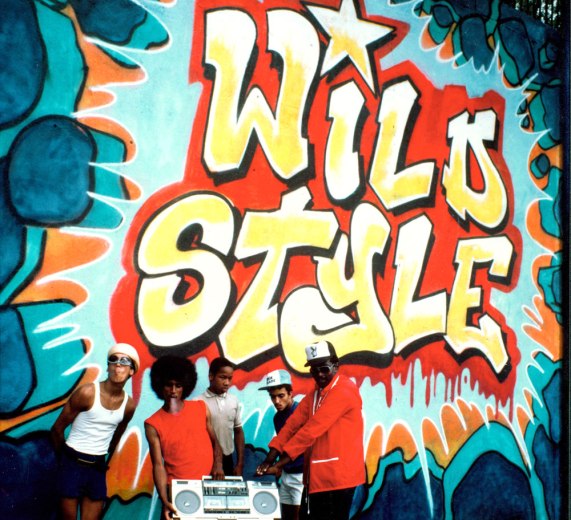
wild-style-e-flyer-old-logo-HIGH-RES
Cult Film ‘Wild Style’.

Graffiti and street art are not a new phenomenon. As with ancient civilisations, humans were writing on walls to decorate them, convey messages and for pure art. In Pompeii, we have seen evidence that graffiti was written on the walls in what would have been a bustling city. In the brothels, there were graphic drawings on the walls on the types of services that were available. There are parts of the world where art must have been drawn on walls or caves with primitive instruments.

10368193_10204244909873114_2895964038190550064_n
Graffiti in Pompeii.

In recent years, there have been real stories of how street art has moved from a covert hobby to a legitimate art form. Whilst researching the topic I found the article The Law of Banksy: Who owns Street Art’ in University of Chicago Law Review by Peter N Salib, who goes into the details of street art for its social value and benefits to the community. He also discusses the financial and commercial value of street art to communities. The rights of property and creative intellectual property rights of the artists are explained in depth.

Banksy is a world-renowned artist, and so he has been keen to give voice to a world that is at times – unfair, corrupt and downright self-destructive. I love it when he collaborates anonymously and supports causes that make me think, shakes up the status quo, or that which is simply sublime. I have only seen a couple of his works close up. One of those was in Tottenham, where the artwork on the wall was removed and sold off for a large profit. I guess that is just the way of the world.

175191_1785641251008_3023219_o
Banksy’s ‘No Ball Games’ Street Art before it was removed in Tottenham.

There are many street artists doing this across the world as you may have noticed on social media. The Berlin Wall and Belfast have been galleries for fabulous street art and graffiti – that have changed the narrative of their recent darker past. I haven’t visited these two cities but their street art culture is very much an attraction and a valid reason for me to want to visit these cities one day.

The Berlin Wall and Belfast have been galleries for fabulous street art and graffiti – that have changed the narrative of their recent darker past. …On global street art.

I particularly like the German street artist Alias too, as a few years ago we had one of his thought-provoking calendars. I actually got excited at the beginning of each month to see what he had to offer as we turned the page each month in the calendar. To see if his art has the same affect on you – see his website for some of his street art!

The best way to see street art is to get out and take a walk. If you would like an informed guide, tours are available in clusters of London. A couple of years ago Rachel Kolsky, of Go London Tours, gave members of SLA Europe a walking tour of the East End of London. It was an added benefit to stumble across all the street art near Brick Lane. You can see the photos here on SLA Europe’s Flickr account.

In Hoxton, Shoreditch and Dalston in London – I usually have to glance at the magnificent artwork as I drive through the city. However, I have been specifically on my own walks to look and photograph street art. The whole creative energy and regeneration of the area has taken place for over a period of 16 years. I have seen changes from edgy rundown buildings to current hip venues and offices. The hoarding boards come in handy to create street art, but there are also many building walls with street art in a concentrated area.

There are many other remarkable areas of street art – such as Camden, Hackney, Islington, along the River Lea, and even closer than close, in my neighbourhood in Walthamstow!

In my neighbourhood, there has been a gradual increase in the number of street art visible around our corner. It is a fact that Walthamstow has seen a lot of regeneration, and the dreaded gentrification (which I am all for!). But also the new street art has created genuine community interest and pride in our environment. Wood Street Walls (Twitter @woodstreetwalls)  is based in my area and have worked with local businesses and buildings to add community colour, statements, beautification and identity with the local area. I can now walk five minutes to see some amazing artwork outside on walls of local pubs, cafes, shop shutters, parks etc.

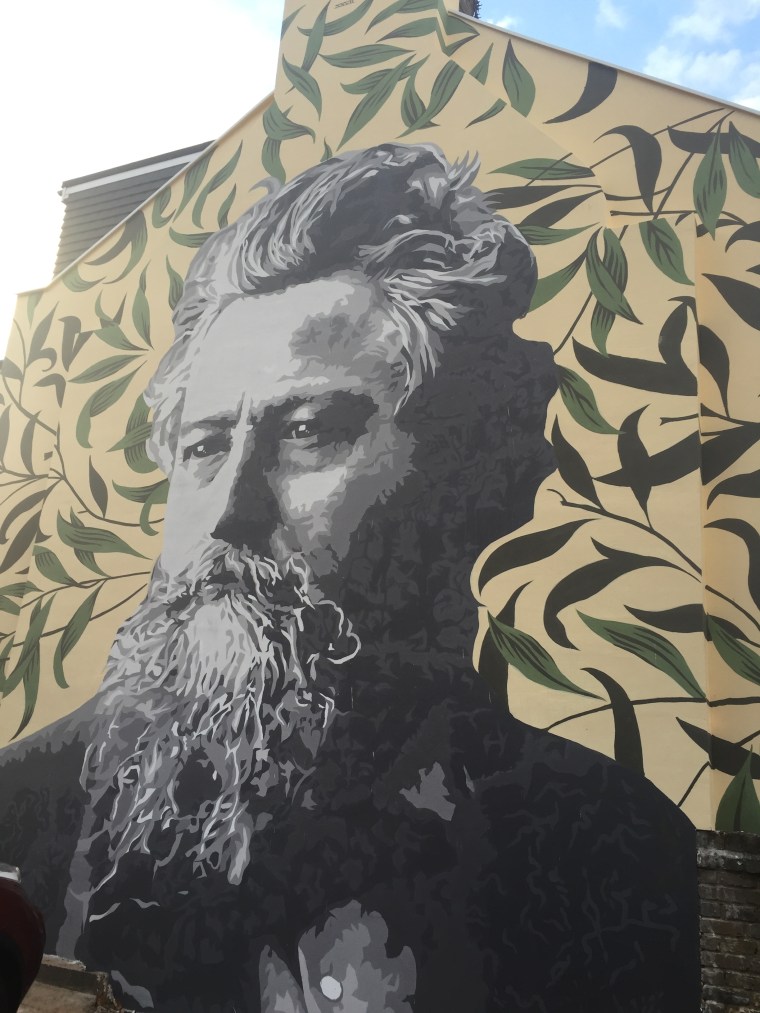
As with most art forms, the community has been great in supporting artists. However funding and space for art works is still lacking, and therefore artists still require the assistance for local and central government. Street Art is fine if the walls are approved but artist also want a space for their art and therefore local authorities should be able to facilitate affordable artist spaces and studios. A couple of business engagement aspects I like are the crowdsourcing campaign by Wood Street Wall for the residents to ‘Pick Their Pattern’ of an image of William Morris that they wished to be painted on a wall near the William Morris Gallery. And campaigns that ran to crowdfund for specific art projects.
IMG_9669
Completed William Morris crowdsourced ‘Pick a Pattern’.

If you are without these in your environment – you can get a copy of the book ‘London Graffiti and Street Art’ by Joe Epstein. It contains great photographs of street art across London, but also some inspirational and admirable quotes from street artists and what their art means to them.

One fabulous quote in this book by artist Zaki Dee 163 – The Chrome Angelz/The Others is: “Having been born in London, and grown up here in the 70’s and 80’s, through the 90’s, I was lucky enough to have been involved in, arguably, the three biggest movements of the last 40 or 50 years. From Punk and New Wave, into Hip Hop, through to the House/Rave scenes – and it’s no coincidence that London was at the forefront of all these subs-cultures when they first exploded onto these shores. After all this time, the UK graff scene is still going strong, and in London you can see some of the best work this country has to offer.”

It is fantastic and uplifting to see street art in clusters, isolated or even in the most unexpected places. They are a joy to behold! And just to keep us hooked…street art changes over time, and so it is worth going back occasionally to see new displays that are freely available to us all.

On the beat with Community Action

It takes a Village to raise a Child – African Proverb

I was born and grew up in a village in Trinidad but I was certainly no country bumpkin! The village, Dow Village, was smallish in size but mighty in activity and life.

Diwali
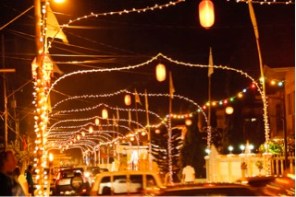
Diwali Street Scene in Trinidad

We were very busy with several multi-cultural, multi-religious, traditional and modern activities, events and celebrations. As I look back at those early childhood years of village life on a Caribbean Island, I realise that we had a special community energy and participation in many aspects. We had bazaars and raffles to raise funds for various initiatives towards sports days, construction of buildings, treatment for unwell villagers, the Temple’s fund, local schools, re-enactment of Ramlila, Diwali Celebrations, Christmas, Eid-al-Fitr, Holi (Phagwah), street and house parties, and other events (please let me know if I forgot any!).  Some of the activities we held would entail selling fresh food, tea parties, Bar-B-Ques, Curry-Qs, playing games, and various entertainment ranging from sound systems to live music (such as tassa drums, Indian Orchestral to local Rock Bands). The village then was busy with life – it never felt boring or backwards.

Residents left their doors unlocked and gates open with low crime levels. Everybody knew everybody and it was used to our advantage – to build our community, to watch out for each other, to have pride in our neighbourhood.   There were bad points occasionally with fallouts but generally my village has stood the test of time. Up to now, I love my neighbours in Dow Village and I am sure that they love me too. We experienced everything from life to death and we can still touch base with each other wherever we are in the world with modern technology. Some of us may have left our villages for the wider world but David Rudder and Carl Jacobs sing in the Calypso ‘Trini to De Bone’:

“There’s no place like home some people say
Though some have to leave to make their way
But in their hearts I know their destiny
To come home and big up dey country” – Trini to De Bone.

I came to study in London over twenty-five years ago and lived in Hornsey and Tottenham initially. I used to hang out in Holloway, Highbury, Stoke Newington and Islington. It was interesting from the offset to experience so many cultures, tribes, languages and communities in North London. These ranged from North Londoners, Cockneys, Post-Punks, Irish, Greek Cypriots, Turkish, Kurdish, Nigerians, West Indians and lots more other ethnicities. It was a new melting pot for me to take in.

I eventually ended up in Walthamstow and was sceptical to move to East London as I had grown used to North and North East London. However, the timing was right again. Walthamstow still had affordable family homes, green spaces, and convenient travel links and a community feel about it. Moving to live here was a very good decision in the long term, and so the community story continues.

Walthamstow was recorded c. 1075 as Wilcumestowe (“the Place of Welcome”) and in the Domesday Book of 1086 as Wilcumestou. It does lie geographically on the edges of London and was a route between London and Waltham Abbey. Today that welcoming community spirit is still alive and kicking in Walthamstow. There are many remarkable things about the town and a few of them include:

  • The famous Walthamstow Market which is renowned for being the longest street market in Europe. I understand it has changed over the years but you can still get great bargains.
  • William Morris Gallery in gorgeous Lloyd Park, which was once the home of William Morris, world renowned designer, craftsman, poet, writer and socialist. His creations, ethos and influence are still relevant and inspiring today.
  • The Village area has old buildings and quaint houses which make you wonder about the past and the people who lived there. There lies too the Vestry House Museum which has permanent and temporary exhibitions, a community room and beautiful garden. I have been on guided walks with Joanne Moncrieff‘s Westminster Walks, who tells you all the facts about the buildings and area to bring them alive.
WGP-LPC2015
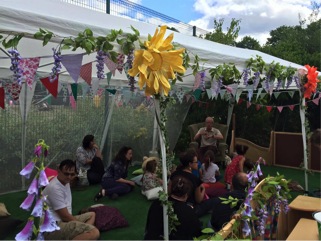
Storytelling by Mike at the Walthamstow Garden Party, The Lloyd Park Centre.

There are two community initiatives that I actively contribute to: The Lloyd Park Centre charity and the Poets’ Corner Residents Associations. Since 2004 at The Lloyd Park Centre, I have been a Management Committee and Fundraising and Events Group member. After many years thinking of helping in a local charity, the timing was right to start. I was inspired to get involved when I heard that this organisation was formed by volunteers in the 1980’s and still depended on community participation in its constitution, operation and strategic direction. It is also the lifetime commitment of inspiring Pauline Thomas MBE. The organisation’s history and commitment over the years is very admirable. In my time there, it has moved from portable cabins to an environmentally purpose-built designed building, and its financial turnover has doubled. I have seen it grow from strength to strength in offering children and family services such as day care, holiday clubs, baby clinics, Dad’s Club, Twins Club, Grandparents support, Autism support, outreach and a franchise of Dolly Parton’s Imagination Mobile Library to a deprived community.

I have volunteered consistently for all these years and have been very ‘hands on’ in attending regular meetings, helping when and where I can with my skills, knowledge and most of all…my time. Committee meetings are not so daunting as you are briefed and guided by the other committee members who are already there. As time goes by, I have learnt from the organisation and challenged myself to activities that I wasn’t aware I could do – for example, I cooked for 200 people in their kitchen for a fundraiser! Generally I plan, organise and run events in my own time and all other activities that a local busy charity requires. I have to hone in on my organisational skills as this is not my day job and from my use of social media – you can see what I get up too! As with everything, nothing stays the same and the organisation is constantly evolving, improving and taking on new challenges.

I am proud that when I worked at PricewaterhouseCoopers I won a financial award for volunteering as part of their Community Affairs programme (Hello David!). They have a long history of Corporate Social Responsibility. I also have won the charity’s Volunteer and Fundraiser award a few times. However, it means a lot more than that to me. Over the years, my volunteering was a team effort to raise money and my goals really were to give support, help as much as I can and to be engaged in an organisation that has made a huge contribution to the local community and families for over 30 years. The last 12 years have been fun, satisfying and helped me developed outside of my day job and profession. It has relit that community flame that I had as a child in Trinidad.

Child is the Father of Man – William Wordsworth

I was made redundant about four years ago when I needed to re-focus my energies and give back to the place where I live once again. Luckily I had the time to volunteer in my neighbourhood residents associations when we were planning our London 2012 ‘Milimpics’ street party. We have our own Poets’ Corner blog and social media channels that have been going since 2012. We have since rebranded to Poets’ Corner E17, as there are streets named after Poets and we are on a corner. We have been constantly engaged in transformational regeneration initiatives that are happening on our doorsteps!

We are also very keen to support local businesses and love our high street. I have seen derelict shops being taken over as pop-up shops to permanent retail outlets. In the last few months – there are several new high street shops emerging such as coffee shops, art shop, craft beer, chocolate shop, giftware, Italian deli and hairdressers. Local venues Ye Olde Rose and Crown, The Bell Pub and Mirth Marvel Maud are used as meeting social places and also are at the heart of the nightlife. The last five years have been amazing, heart-warming, social and definitely local.


10369605_10203719881467732_1345985400225628703_n
Little Free Library Project – in Poets’ Corner.

We have continued the spirit of London 2012 Olympics with many activities including an annual street party simultaneous as the national Big Lunch celebrations, spring cleaning (which has made me obsessive about dumped rubbish and litter!), crime-watching, Halloween Party, Puppet Show and fabulous Christmas Carolling on the street. We have also taken part in the magnificent E17 Art Trail which has made us work collaboratively to display Estate Agents boards as ‘Poets for Sale’ with poems in our front gardens. For the 2015 project, we created ‘I want to tell you a story…’ stories on places on Walthamstow. Residents Barry and Lesley Coidan have been the driving force for a lot of these initiatives and deserve special recognition and appreciation. Before I forget to mention – we also have two Little Free Libraries in the neighbourhood, which started in Walthamstow for the United Kingdom (original idea is from the USA).

poets-for-sale


Why am I telling you this? I enjoy taking part in community events. I also think there is a special energy that I have been lucky to experience in my homeland of Trinidad many years ago, and here now in Walthamstow. It is very fulfilling and reassuring that we have neighbours and people in the community that we can rely on, pull together and to contribute to our society on wider urban issues, such as crime prevention, sustainability, environment, economy, culture, festivities and general awesomeness.  You just have to remember the terrible London riots of 2011 to recall what it is like when neighbourhoods fall apart and communities are at threat when you take your eyes of the ball.

I don’t have my own business but if I did – it would be based on the arts, crafts or food in the community. Volunteering has made me certain about that and myself. With Utopian and socially ethical views, I would feel compelled to consider where I live, the people it is going to affect, how we can work together to make our part of the world better for ourselves but also for my immediate neighbours.

Anyway, I really love taking part in the fun, and all the exciting energy and buzz of Walthamstow. We are celebrating our next Brazilian theme street party soon in tuned to the Brazil 2016 Olympics. And so the beat goes on, and on.

Networking in a small world

One of the best aspects of working in Business Information is that both information suppliers and professional organisations are generous and committed to helping clients and members to network and get to know each other.  I have been fortunate to be going to these events across London for more than twenty years, and relish seeing old friends and making new acquaintances.

In the 1990s and 2000s, the City Information Group was a professional association that hosted networking and social events across London in fabulous locations.  Some of the memorable events were held at The Dorchester Hotel, The Conservatory at the Barbican, an Art Gallery in Bermondsey and the Dover Street Arts Club (Yes my friends, I still remember the quail eggs canapés and potent wine).  Most of these events were sponsored by information and online services providers. So it was a very cost effective way for me to network, discuss interesting topics and purely for having some fun (I see nothing wrong with that!).  Most of all, I still see myself as a tourist in London and so enjoy going to new venues.  Sadly, the City Information Group no longer exists.

I have been a member of SLA Europe for 14 years and they are great at arranging networking events, educational seminars and tours across London. I get so much value for money from my membership, and honestly, I am not just saying that because I am their Membership Chair.  SLA Europe are always hosting events that are on the cusp of the information profession and industry SLA_Europe Logosector, such as ‘The Future of News’, ‘Tweeting while you work’, ‘The Evolving Value of Information Management’ etc.  Their programme of events over the years has been exceptional for networking and for visiting interesting buildings such as Dow Jones at their News Room, Nomura Bank on the Thames riverside and the quirky Barber Surgeon’s Hall in the city. Some of these venues shown on SLA Europe’s Flickr account are private offices or corporate venues to hire, and therefore they would not normally be open to the public.  There have been many more fun and interesting events over the years but I can’t remember them all. Along my same train of thought, here is a handy recent SLA Europe event review written by Vicky Sculfor with Top Five Tips for Networking.
“We are shifting from people who manage collections to people who manage connections.” – Deb Schwarz. SLA.

Timely too, is a relevant article and quote above from Deb Schwarz in SLA headquarters’ journal ‘The Connected Librarian – More than Social Media’, Information Outlook, March-April 2016. Deb evaluated from her colleagues that the “guide to the future of our profession” are:

  1. The connected librarian is about building and strengthening relationships, both within and outside the profession as well as personal and virtual.
  2. The connected librarian creates and maintains a linkage to time—past, present, and future.
  3. The connected librarian links people to increasingly diverse types and voluminous amounts of information.

Bureau Van Dijk (BvD), an online provider for business intelligence and company data, host two parties a year for their clients, often in museums. I try to make sure that these are in my diary! Some of these museums have been so remarkable, that I want to mention them specially:

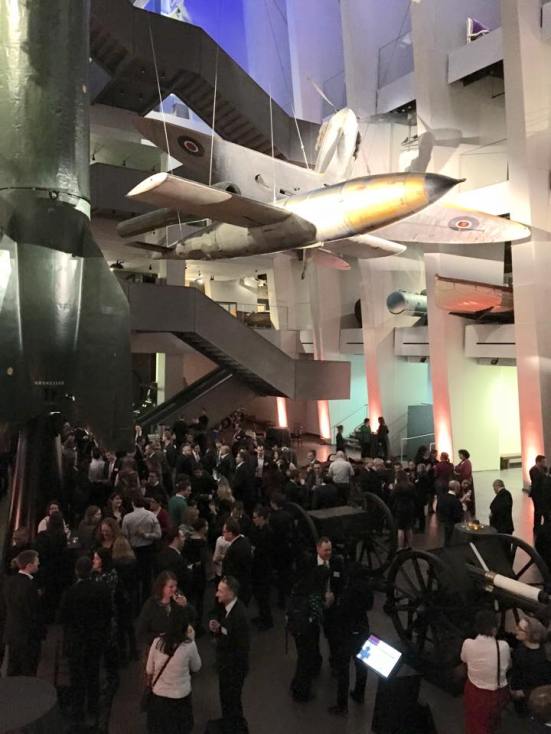
  • Imperial War Museum (IWM) – covers conflicts, especially those involving Britain and the Commonwealth, from the First World War to the present day. The IWM was renovated recently and it was special to be there in 2014 on the 100th anniversary of the first world war.

    10502216_10205668221135006_1480443024503753387_n
    A V1 Doodle Bug hanging over the BvD party at the Imperial War Museum
  • Hunterian Museum at The Royal College Of Surgeons – has unrivalled collections of human and non-human anatomical and pathological specimens, models, instruments, painting and sculptures that reveal the art and science of surgery from the 17th century to the present day. This was the most surreal venue to network! Where you are surrounded by thousands of glass medical specimens whilst mingling and drinking canapés! The display meant I could not manage to eat in there but it is a must to see, if you like that sort of thing.

    Crocodile and egg from Hunterian Collection2
    Hunterian Museum
  • The Natural History Museum– has 80 million specimens spanning billions of years.  It is always amusing and enchanting regardless of the time of year or how many times you go.  In 1995, I went behind the scenes on a private tour with a Brazilian Marine Biologist relative who was visiting London. We were shown extinct specimens that are inaccessible to the public.
11209456_10207523672080120_3649364056320123422_n
The Natural History Museum
  • Wallace Collection – has unsurpassed displays of French 18th-century painting, furniture and porcelain with superb Old Master paintings. Earlier this year, we were impressed by the grandeur and exquisite French styled rooms and artefacts of a bygone era.  It really is special, educational and heartwarming that we still have these treasures in museums for our collective history.
IMG_6884
Selfie with Colleagues in the Boudoir at the Wallace Collection

As I conclude, Librarians and informational professionals are one of the most connected professionals.  Long before the Internet and LinkedIn, we have relied on our network for career development, to share information and knowledge.  As professionals, we are still active face-to-face as well as tuned in virtually, and use this interconnected and interoperable network in an increasingly small world. Be it in search of good, sad or bad news and information – we are able to rely on our network to find, provide and support each other to show that we can help or that we care.  Some sceptics may disagree.  One thing is for sure – Librarians are certainly not boring!

For these reasons, I am a staunch believer in the idea of Six Degrees of Separation where people are linked in the connectivity of a modern but also digital world. I once helped to host a seminar entitled ‘Creating Connections’, where we demonstrated that people are linked from high official positions to people in the most remote places on Earth! But seriously, you can read more on this idea as there is much written on it in books and on the Internet.

When I need to extol the benefits of my profession – I always say that these social person-to-person networking events are a great opportunity for personal development and for business.  Networking is a dedicated and fun time where reconnections and new connections with people are made with great camaraderie in quirky, grand and historic buildings, usually with food and drink.

I hope I have convinced you. What are you waiting for?

Trinidad Carnival is Colour

Well, I have finally done it! I have my very own blog after many years of suggestions from friends and acquaintances that I should have my own online space.  I am a fairly prolific social media user, have blogged for work, guest blogged and used collaborative technologies since the 1990’s as work in libraries and information centres.

In the past I am too busy with other things to have time to blog, but I feel the time has come to merge my stories as they become interwoven into one space.  It may be easier for me to do this here due to the info centric, rich connections and experiences I encounter in my simple life, community, work and profession.  Let’s face it … this online space is for everyone to use for good and I also want to use this as an archive for future reference.

For my first post, I wanted to write briefly about Trinidad Carnival which occurs every year two days before Mardi Gras, directly followed by Ash Wednesday and Lent.  It is a time of year where I instinctively feel excited, and try to tune in from wintery cold England to the heat, energy, bursting creativity and vibrant colours or as wef4ffd61ffe17e19013e28c4547029b39 say… bacchanal (derived from bacchus) that is Trinidad Carnival.

The history of Trinidad Carnival is long and goes back to the 18th Century when the European plantations owners celebrated masquerades before lent.  Their African slaves were not allow to take part but formed their own caboulay celebrations. Here they developed mas’ (abbreviated from masquerade) as we know it now – whereby African musical and dance traditions fused with European masks and costumes into an eclectic and exotic mix.


And so I am writing this in London, but my heart strays away to the land of my birth this time of year. From as early as I can remember, I can remember Carnival! Carnival is part of the Trinidadian (Trini for short) psyche, mindset and makeup (no pun intended). Children would take part in schools by making masks and costumes. Usually schools arrange a bit of a “jump up” dance for the parading of these creations on the Friday before the Carnival weekend. There would be an extra tinge of excitement in the air as it is the start of four days of holidays for the Carnival celebrations. The actual big and commercial celebrations usually start the previous year with the launch of Carnival bands, parties or ‘fete’ as we say, being once a French colony. This is big business now, for when one Carnival finishes, the planning for the next year starts immediately after a short break.

I found some gems of carnival video clips from the 1950s when British Pathe digitised their archive.  The effort that went into the costumes are stunning with wonderful results.  I wondered if they were funded centrally or whether the costumes were made out of their own pockets! Anyway, I love the themes such as American Native Indians, Egyptians and all the other finer details in the mas. In the 1970s and 1980s, I had noticed even then that cameras and broadcasters transmitting the parades to people’s homes and possibly abroad.

As a child, I used to be excited waking up on Carnival weekend as the whole weekend would be a visual and rhythmical treat. Saturdays during the day would be filled watching on television the ‘Kiddies Carnival’ and later that night, some of the steel pan ‘Panorama’ competitions. The show usually finishes late, so I sometimes never saw all of the steel bands. What people don’t realise – the steel bands themselves in Trinidad are massive and consist of scores of musicians and organisers.  The orchestras fill a large part of the epicentre of the competitions at the Queen’s Park Savannah stage. The flag bearers were generally women who danced away to the steel drums on stage and were a treat to watch too – they waved it and shaked it!

On Sunday there would be the Dimanche Gras competition showcasing the large Kings and Queens Carnival costumes and the Calypso competition.  This is no longer the competiton format but it was exciting to see it then over the weekend.  The televised shows always made exciting live viewing and that was very special about Trinidad (this year I listened to live radio via the web in London and have seen live streaming on the web too in the recent years!).   

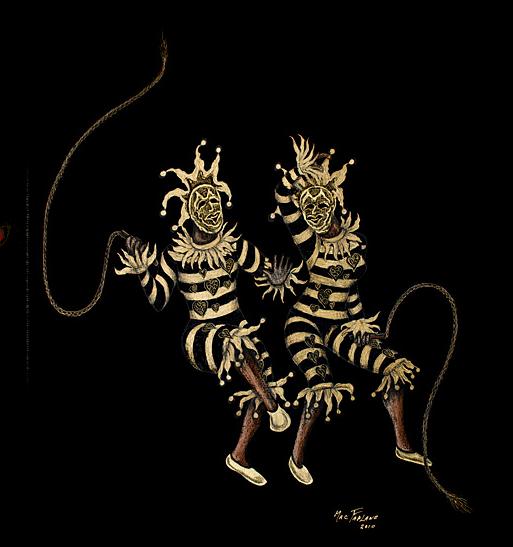
I remember the costumes being very elaborate and colourful in the late 70s and 80s. Now the costumes are still beautiful but a bit monotonous, as they are mainly bejewelled bikinis with feathers.  Don’t get me wrong – I guess this has made mas more accessible and now everyone can afford to participate in a piece of the action in an all-inclusive Carnival band.  A relative told me that most of the big bands mas are currently manufactured in China. However, I saw a few years ago that some top designers such as Brian Macfarlane still make theatrical theme-based mas, and also there are still organically handmade costumes in some communities across Trinidad.

mcfarlane-jab-jab
Jab Jab – Brian MacFarlane.

On Carnival Mondays, we would wake up to young children in my hometown Dow Village wearing their homemade masks.  They will go door to door chanting slogans and making noisy music with a pan and stick expecting small money for their efforts.  Pocket money  was given as an appreciation for their efforts.  Sadly, I understand this tradition doesn’t happen now in my village. From early morning on Carnival Monday when it is still dark, there would be live television broadcasting of J’ouvert – the official start of the adult Carnival on the streets of the cities.  I only attended J’ouvert once in Port-of-Spain circa 1985 with relatives and we got there for about 3am in the dark.  It was amazing to witness and participate in a celebration with people dancing on the streets at that time in the early hours of the morning.  The debauchery, dancing and parading would continue into the daylight of mid-morning. This is broadcasted on live television too, if you can’t go out to the streets. In recent years in London, I love seeing dawn tweets of Trinidad J’ouvert on Twitter.

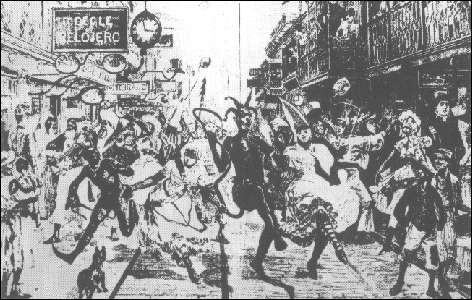
J’ouvert leads on to the official parades of bands. Historically there is no wasting of time on the start of Carnival and revellers make the most of time before the Ash Wednesdays cool-down.  The rest of the day would be spent watching the Monday parades of bands on the Television.  My village had traditional celebrations such as Jab Jabs (derived from Spanish for diablo) dressed as devils with whips.  Unique to my village, some East Indians in the community would also have a parade to the beat of East Indian tassa drums to the next main town Couva.

On the final day that is Carnival Tuesday, our parents would always take us to Port-of-Spain (my mother’s hometown) to see the mas meeting up with our large family with homemade picnics and snacks for the day including delicacies like our own Trinidadian pilau (mixed rice dish with meat, pigeon peas and vegetables).  There we would be based all day to see the great and traditional masqueraders displayed on the Queen’s Park Savannah stage.  We would see traditional masqueraders such as the Sailor Bands, Midnight Robbers, American Indians, Minstrels, Moko Jumbies on stilts and blue devils covered with blue powder to name a few characters. There too, we saw the great bands of 3000 plus masquerade members by designers such as Raoul Garib, Wayne Berkeley, Stephen Lee Heung and my all time favourite designer – the world renown Peter Minshall.

Peter Minshall not only created beautiful exquisitely designed costumes for Kings, Queens and his band members – he retained the theatrical themes and origins of the mas with performances on the main Queen’s Park Savannah stage. Frequently his costume designs were provocative for social and political commentary with theatre and drama.  For example, I remember vividly on television the King of Carnival performance and showcasing of Mancrab for his band theme ‘The River’ – it was pure drama!  This was aired live on television to the movement and sound of calypso music.  I still think of the year he created the band Rat Race and the vision of hundreds of people dressed as Rats in the ‘savannah’ and on the streets of Port-of-Spain.  It is hard to cover all the beauty, vibrancy and growing up with Trinidad Carnival but they are cherished memories of the creativity and the celebration of our people.

71e9ba6f8dbf6f74f5bf557e14a01e2c
Rat Race by Peter Minshall.

On the business side of Carnival, Minshall is renowned for exporting his talent and creations at major global events such as the Barcelona and Atlanta Georgia Olympic Games Opening ceremonies.  He is also credited for designing the Tall Boy which he patented and invented with Doron Gazit.  It was great to see him also back from a haitus from Carnival in 2016 with his design of ‘The Dying Swan’.

There would be no Carnival without music.  Kaiso and the oral traditions came over with African Slaves and evolved into calypso and eventually to the modern day soca (soul and calypso).  The development of this music genre is innovative and laced with fusion beats and can be social and political commentary but generally is more upbeat, rhythmic with innuendos for having a good time.  Nothing can beat a good calypso to get a fete going or everybody on a dance floor or street. I still actively look forward to the new music releases and social media is a great tool for that hobby.  I remember when I first came to London, I had no clue what the latest releases were as I tend to listen to mainstream British radio and not the UK soca radio stations.  I used to receive cassettes sent over with relatives who went to holiday to Trinidad. Thankfully now I can find music on online radio stations, You Tube and via my own social network.  Forbes recently published a list of Carnival Entrepreneurs with the Trinidad Carnival Powerlist and there is much talk that soca music is finally going mainstream. I hope so, with so many Caribbean Carnivals being celebrated across the globe.

This slideshow requires JavaScript.

At the British Library where I currently work, this is the final week for the dazzling exhibition ‘West Africa: Word, Symbol, Song’. I am extremely grateful to the curators of the exhibition for helping me understand the world and for my own self-discovery as an Indian-Trinidadian. I learnt so much about West African culture and its oral traditions, ancient manuscripts, symbols, fabric, musical instruments, musical history and art forms. It was also an immense pleasure to see the ‘Carnival Queen’ designed by fellow Trinidadian Ray Mahabir on the speaker-box with a nucleus of calypso and soca music curated to visuals of Nottinghill Carnival inside the speaker-box. Being in there, it was one of the moments when you can see all the dots joining up – a world connected. Old with the new.

Being in there, it was one of the moments when you can see all the dots joining up – a world connected. Old with the new.

I feel I can write a book on my experiences on Carnival, which has been dubbed a long time ago as the greatest show on Earth. I borrowed a few books to research from the British Library before my visit last year for Trinidad Carnival, and it has been documented for its social, cultural and delightful impact.

Today in London,  I wanted to remind those who know me that it is Carnival Tuesday and I can’t help my thoughts straying to Trinidad and that infectious energy, freedom, rhythms, empowerment and colour of my country and the people.   Later this year, I look forward to a little bit of that enjoyment at the Notting Hill Carnival in August.

This slideshow requires JavaScript.