The Evolution and Revolution in Music – a personal journey

There will always be a fascination with inventions, innovations and new development in music and musical equipment, whether for broadcasting and our personal enjoyment. Coincidentally, it is also a time of immense changes and disruption in the music industry, and also our own personal experiences with these adoptions and evolutions. Innovations in musical equipment have moved from the physical to the digital, starting from the wax cylinders, phonographs, vinyl, cassette, mpg file to streaming. I may have left out quite a few formats here but forgive me for my ignorance. Here I will try to cover some of these changes with some of my personal experiences.


This slideshow requires JavaScript.

It may be back in the 19th Century, but occasionally I get asked at work to search for patents on musical inventions, which is very interesting.  In the article In what’s your best innovations yet?’, there is a brilliant description of musical history and our experiences in a nutshell. The explanation goes: “…before the invention of the phonograph people could hear music only when it was performed. When Thomas Edison and Alexander Graham Bell began working on their phonograph in the late 1800s, their primary objective was to desynchronise the time, and place of a performance so that it would be heard anytime, anywhere…..Emile Berliner’s flat disc-shaped records and later, the development of magnetic tape made it significantly easier to mass-produce recordings, lowering their cost while increasing the fidelity and selection of music available. For decades, however, players were bulky and not particularly portable”. Does this sound familiar to you? This is a quick whistle stop of earlier musical inventions but you may have experience some similar changes too in our lifetime.


This slideshow requires JavaScript.

I wanted to blog about the evolution of music from my own experiences, but it is with great coincidence and significance that the British Library held a recent exhibition entitled ‘Seasons of Sound – 140 years of Recorded Sound‘. This was a visual and interactive timeline of sound equipment, technology, culture, sub-cultures, and the impact these have had on society. This was the library’s first sound focussed exhibition – described as an exploration of how “sounds has shaped and influenced lives since the phonograph was invented in 1877”. The exhibition aims were to demonstrate how innovations in recording technology and radio broadcasting have transformed our listening experience. The exhibition was great to see (and hear…and feel) how equipment, technology and developments in recordings have progressed in this period, especially if you are a music fan. Working at the library, I have also answered queries on historical patents, including inventor and entrepreneur Emile Berliner and the phonograph!


This slideshow requires JavaScript.

I had the privilege of also attending a guided tour by two of the exhibition’s curators. Some of the items that were highlighted were 16-year-old Alfred Taylor’s wireless log – which apparently would have been like a modern day vlogger or You Tuber. We were told that the first set of live radio broadcasting was not recorded in his diary, as there were a lot of “false starts”. It was also quite exciting to hear about the launch of live broadcasting at the turn of the 20th century, and so it seemed this had gripped the public’s imagination with a fascination for live shows. You can just imagine the development of such well-known media outlets such as the BBC, the rise of record buying, the pop charts, broadcasters, live shows – and the rest they say is history! One point the curator wanted to convey was that “the library is remembered for its books, but this exhibition was focussed on sound and listening and to raise the profile of the sound archive”. So look out for the Save our Sounds Project and for more ‘Season of Sounds‘ events on until this autumn.


This slideshow requires JavaScript.

We have reached a stage where these inventions and innovations are ever-changing and so we can all relate to a period in time when we consumed music in one or another format. We have experienced, witness and moved from the early days of audio through to the digital age.

It still amazes me that there is so much personalisation. Andreas Pavel first created The Walkman in 1979. Apparently, Andreas wanted to create it but found resistance from the head of Sony at the time. However it was later launched.


800px-Original_Sony_Walkman_TPS-L2
“They all said they didn’t think people would be so crazy as to run around with headphones, that this is just a gadget, a useless gadget of a crazy nut,” Sony on Andreas Pavel’s idea for the Walkman.


In the book ‘Inventions in the 21st century’, my ex-colleague wrote the following on the personal stereo: “the story is great for the birth of the idea where Sony’s head realised that young people loved their music and did not want to be without it”. Sony’s marketing staff were apparently not convinced that the product would sell, but after launch in April 1979 – 100 million units were sold. Certainly, this is a forerunner of the smartphone and other such devices as we know them now – but the rate of development has been steadily improving.
WybJWNdJ
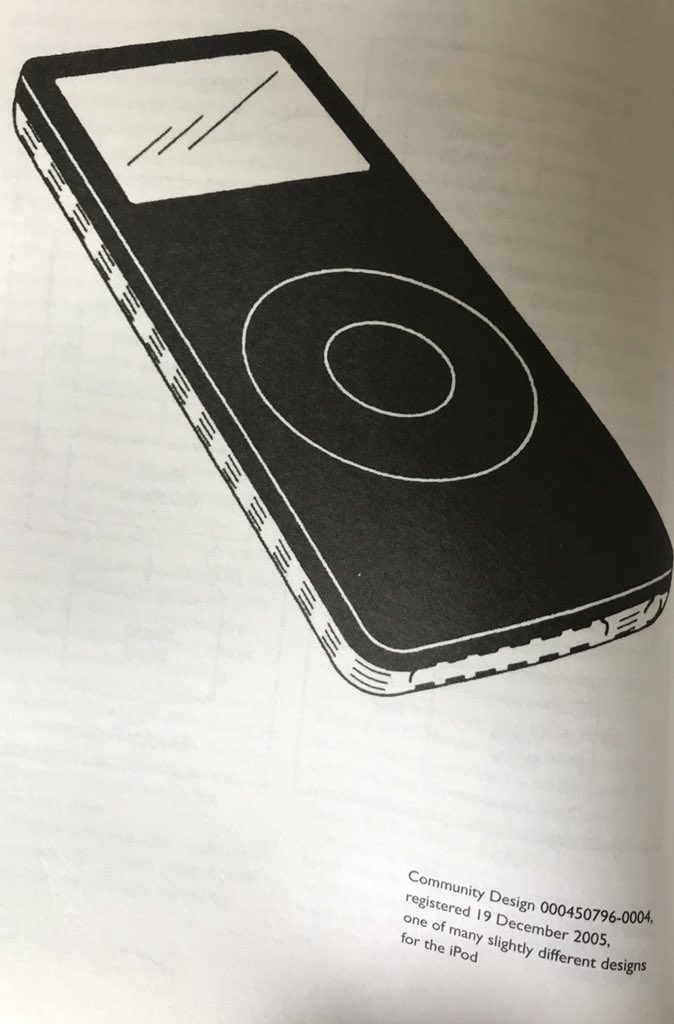
The iPOD MP3 Player – ‘Inventing the 21st Century’ by Stephen Van Dulven

Despite the current move to the digital age, Vinyl has seen a resurgence and renaissance in their sales with more millenials discovering vinyl, and obviously record players too. Who would have thought that that vinyl would have their own best selling charts again? The experience of crate digging in a record store or in a pop-up shop is still a self-fulfilling experience. Some record fans have always preferred the physically activity of selecting, loading and playing records. Not forgetting the historical and artistic contribution of record covers designs. I used to get lost just looking at record covers and lyric sleeves. All of this is even more fun and better to share with friends and loved ones. I have loads of record stories but I remember our Italian relatives in a band asking us the lyrics to Steely Dan’s ‘Do it again‘ before we had access to the internet – we had to keep rewinding the cassette until we got most of the lyrics. It’s so easy now.


This slideshow requires JavaScript.

I grew up in the age of vinyl in Trinidad were we bought hundreds of vinyl 45” and LPs in the late 1970s and 1980s. However the late 1980s saw the adoption of CDs and by this time, I was a foreign student on a budget in the UK, and so CDs were too expensive and a luxury for me to buy. However, I used to buy cassettes and also taped my favourite sounds from radio (for personal use). I buy music occasionally still and I continue to listen to the radio a lot compared to buying music. In the last 20 years, I have found the development from cds in the 1990s to the present fast moving and revolutionary.


This slideshow requires JavaScript.

By the late 1990s, the Internet had disrupted all of this but also acted as a catalyst for a lot of innovations. You may recall Napster from about 1999. In the article ‘What’s your best innovation bet?’ by the Harvard Business Review July-Aug 2017 (link above), Melissa Schilling writes: “soon after the file-sharing platform Napster launched in 1999, consumers were downloading new music and film by the millions, and Napster like services were sprouting up like weeds”.

These disruptions were obviously having an impact on sales and the industry. The latest music statistics are healthier but in another article, ‘The trouble with streaming music: how to dig a new hole’, the argument is that the “macro trend is that music sales in real dollars have been decreasing every year since 1999, concerns in this digital age is that the model of the music has not only shifted in the democratisation of music. No longer are we tied just to the artist we hear on FM radio. In no other time in history has it been possible to sample so much music with so little fraction or cost”.

Another milestone in the development of music is without doubt by the company Apple. Steve Jobs, Apple’s late CEO, loved music and incorporated music listening in the design when Apple was developing the iPod – “an iPod, a phone and internet”. This leveraged the mp3 for a new generation. The revolution in music continued with iTunes, and now to Apple streaming music. The news is that Apple Music is now a rival to iTunes as mentioned in the report Streaming resuscitates entertainment industry, but operation bypasses retail where it states: “Apple’s entrance into streaming with Apple Music has resulted in limited investment in its original platform”.


This slideshow requires JavaScript.

Up to date in the 2010s, this leads me to explore the new world of music streaming, which is tied in with the proliferation of the smartphone. The general topics are: rights and revenues paid to artists, how much of our spending ends up being owned by us, algorithmic versus personalised selection, and the interaction levels that are now possible. The rate of these digital changes is phenomenal! In this BBC article, the figures says streaming generated $7.1bn (£5bn) in 2017, more than sales of cds and vinyl. The number of people subscribing to a streaming service topped 176 million, up from 112 million a year before’.

Streaming has been around for a while but I have intentionally started paying more attention to its development and also using it too recently. I have had a Spotify account for my elder son for a couple of years, and I recently took out an Apple Music family account for my younger son and myself. It certainly is amazing how easy it is to have seamless, mainly banter-free and advert-free music streamed for your pure listening pleasure. You can let the algorithmic system work the magic with serendipity, smart searches and suggestions for you. An extra bonus is that you have access to millions of sounds at your fingertips and ears. For example on Spotify, you can see what your friends are listening to, have access to a whole album instead of a single, and various information and user-centric data. How cool is all this! Do you remember talking to your friends at school about new pop music? Then we had no You Tube links neither streaming music to discuss whilst showing them on our smartphones. So streaming music seems like a whole lot of fun whatever the genre you like – especially if you are passionate about music.


This slideshow requires JavaScript.

The streaming music market is now rampant with competition with Google Play Music (owned by You Tube Music), Spotify, Apple Music, Tidal, Deezer and Amazon etc. I certainly don’t and can’t afford to use them all. There are billions of pounds in the music streaming business – but what about the artists? In terms of rights for the artists, it is argued in ‘The Trouble with Streaming Music: How to dig a new hole’ that “you can explore 100 artists that all sound similar to one you put with their algorithmic, but you will never get anything that blows your mind the way that one guy in college was able to do when introducing you to something completely novel”. It is the same occurs when you discuss with friends, or go to a party and accidentally come across a track that you may not have heard before. Music knowledge is great to discuss with a person face to face. The one suggestion for streaming music’s success says “to combat the economies of streaming services depriving artists of a working wage, and to keep new music coming out – is to buy more music, see more shows, and buy more merchandise”. This is the reason why touring artists and live shows are still very profitable for revenue and encouraged by both struggling and successful artists. They need their fan’s support too to survive.


This slideshow requires JavaScript.

I do still have personal dislikes for streaming music – with my total cost of money spent a month averaging about £30.00, it still will not be wholly owned by me such like the 45”, albums, cassettes or cds that I owned in the past. Also although I only have experience of Apple and Spotify, it does not allow me access to the eclectic world music catalogue that I like. I frequently do not find songs on streaming that I know exists! You Tube videos may be better in those instances.


This slideshow requires JavaScript.

I am 100% sure that music consumption and inventions will continue to evolve in time with new visionaries, ideas, technological developments and experiences. Generally, I feel all will be well with the future of music and the artists who make these beautiful melodies. How do I know this? Our love for music will be at the heart of all this driving the changes, and we will show that we do care.

Shake, Rattle and Roll – Dance until you drop

Dance, when you’re broken open. Dance, as if you’ve torn the bandage off. Dance in the Middle of the fighting. Dance in your blood. Dance when you’re perfectly free.

– Rumi

I have now come to the point in life where wisdom makes me see and appreciate the more important and finer things in humanity and life – Dance is one of them. Those of you who have known me since a child would recall that I have always loved dancing. We have danced together in our homes, schools, at parties, clubs, on the street and even in our kitchens. My parents were keen dancers and even my mother showed us the steps to calypso and meringue dancing. Apparently, my paternal grandmother was a dancer, which explains a lot of my family’s enjoyment in dancing – it must be in our DNA. My only regret is that when asked by parents on whether I wanted to take classical Indian Dance lessons…I said no. Recently my mother reminded me of this to my horror and deep regret. However, it seems like every week this month I have been to a musical event or dance show at the theatre. That is exactly the way I like my social life – with some form of dance or music.

This slideshow requires JavaScript.

In this post I would like to cover some of my thoughts and activities on dancing. As an art form, we should support the performing arts, venues and persons who facilitate and teach dancing for its real cultural, financial and emotional value. Dancing also helps us lead healthy lives, feel happy, keep us entertained and improve our general well-being regardless of age, background, geographic locations, ethnicity etc.

Dance is like time itself. Just like our solar system – dancing has been around for as long as humanity as an art form of performance, expression, social interaction, connection, rituals, entertainment, spirituality and a reflection of life. According to Dancefacts, the oldest evidence of dancing comes from the UNESCO listed 9000 year old cave painting that are found in Bhimbetka, India. The rock painting depicts scenes from hunting, childbirth, religious rites, burials and most importantly, communal drinking and dancing.

Rock_Shelter_8,_Bhimbetka_02
Bhimbetka Cave Drawing, India

Fast forward to the ancient Egyptians and Greeks also showed proof of the development of dance in their culture – most notably at the start if the ancient Olympic Games. Dance integrated with drama in theatre, music and other celebrations through to the western world with ballet in the 18th century. Other 20th century two-person classic dances such as the waltz, foxtrot, tango, Charleston, swing, hip hop, breakdancing etc may be more familiar to us. Dance is ever evolving with new trends, moves, beats and influences. There is a 21st century fascination with popular viewing of dance competitions in our living rooms with the television programmes like ‘Strictly Come Dancing’ in the UK and ‘Dancing with the Stars’ in the USA. We still go to see dance in theatres that tell us stories, showcase professional talent, or simply, we participate in dance to celebrate life.

This slideshow requires JavaScript.

My parents would take me to see dance live shows in Trinidad such as the ‘Mastana Bahar Pageant’ and touring Indian dancers. African dance traditions are also celebrated in the ‘Best Village’ competitions that I saw on Fridays on television and inspire Carnival moves like the Moko Jumbies. There was also a Latin dance tutorial television series on Monday nights, but I can’t remember the title of the show. Dance is still very much part of the social life in Trinidad and integral to the Trinidadian psyche. There are few people there who cannot move in time to the beat regardless of background or age.

This slideshow requires JavaScript.


Let us read, and let us dance.

These two amusements will never do any harm to the world.

– Voltaire

Currently, Dance is an important part of our both our everyday sports and culture without us noticing it. It makes up a large amount of a theatre repertoire with music, acting and other stage production. According to Statista, 22% of the UK population went to a ballet, a dance performance or an opera annually. In 2016, 7.9% of adults participated in a form of dance other than for fitness. Dance has also evolved and morphed into some major fitness exercises such as Zumba, Body Step, Street Dance, Soca dance etc. According to Statista, “the most common reasons to choose a style of dance fitness is the music, of which Fitsteps and Zumba appear to be on the rise in popularity among dance fitness professionals”.

In terms of my own fitness goals – I should try to make time for dance fitness lessons and will try to be more proactive about this as a new Salsa class has started in my neighbourhood. I am certainly a freestyle dancer as I have little professional experience. However, I have immense admiration for professional dancers who have followed that dream and trained long and hard.

I took salsa lessons locally between 2001-2003 every week, and even went to some central London dance venue as I got to a fairly good level. However, I haven’t taken dance lessons since then…but may take up salsa lessons locally again with ‘The Salsaman’ dance trainer. There are also a few local community dance groups in my neighbourhood that use social media to effectively promote their classes. Zumba is another fitness-dance form that has taken over the world in the last decade.

This slideshow requires JavaScript.

Big business also uses dance for capturing our attention with engaging adverts. Multivitamin brand Berocca introduced a new brand character, Roccy the Chameleon, in March 2017. Their effective use of the eye-catching Chameleon dancing and body popping moves to Punjabi music, communicated how the brands supplements can help to combat tiredness and fatigue, and ended with the tagline ‘Be more Berocca’. They also ran a marketing campaign that was supported with social media activity, and ran advertisements on the London Underground to target commuters who are a key audience, according to Mintel (Vitamin & Supplements 2017). There are other fabulous creative uses of dance in advertising, such as some of my favourites like Guinness, Adidas, Pepsi.

In my work-life, I have taken part in line dancing, loved the Big Dance initiative and attended a Georgian Dance talk and demonstration. Dance is serious stuff too!

This slideshow requires JavaScript.

If you are in contact with me via social media, you would see that I am frequently out ‘socially’ at local events and Caribbean parties. All good for the the nighttime economy. In the last few weeks, I have attend the following events where I was able to have a little dance:

3 March – YSBD (You should be Dancing title inspired by Saturday Night Fever) which occurs regularly at the Walthamstow Trades Hall. It is usually for adults with cheap entry fee and drinks. I also don’t have very far to go for a fabulous little boogie.

10 March – Chutney in London at Funky Brown in North London was an opportunity to catch up with my West Indian friends and to enjoy some Chutney Indian Caribbean fusion music and dance.

16 March – Rose and Crown for a birthday party where the DJ were playing Northern Soul Music and general British Pop music. I can always judge a fab party when I stay later than I intended.

4 & 23 March – Mirth Marvel Maud theatre for live band Dennis Rollins and Funky Funk, which eventually got us all to our feet. And Jazzy B’s DJ set, the entrepreneur and musician behind Soul II Soul, who played some fabulous soul and neo-soul music. There was one track (I wasn’t aware off) which had the crowd buzzing.

17 March – ‘Tango after Dark’ show by Sadler’s Well at the Peacock Theatre. This was an Argentinian touring group with sizzling dance choreography accompanied by a live band and singers. It was a treat to see, and reminded me of other gorgeous Latin dance troupes ‘Brasil Basiliero’ and ‘Havana Rakathan’. I also have been to see Swan Lake by Walthamstow’s Sir Matthew Bourne a couple of years ago. So do keep an eye out for Sadler’s Well shows.

This slideshow requires JavaScript.

And those who were seen dancing were thought to be insane by those who could not hear the music. – Friedrich Nietzsche

These are just simple ways I can still enjoy my passion for dance with music, and it certainly won’t be the last I mention it. Again, I find that there is so much on dance that I can write about. I am sure to return to the topic again. Dance will continue to fulfil us with joy, entertainment, inspiration, enlightenment, togetherness and connectivity with other cultures, humans and music. We should seek to support dance companies, professionals and the art form itself. If like me, you just like to have a little boogie when you can – just do it! And be sure to dance until you drop.

This slideshow requires JavaScript.

Ring out the Old, Ring in with the New

“Ring out the old, ring in the new,
Ring, happy bells, across the snow:
The year is going, let him go;
Ring out the false, ring in the true.”

Alfred Tennyson

I am writing this at a restful festive time after Christmas when most people tend to wind down with family and friends during the season’s celebrations. It is also a time when I mentally close off the year in my mind. I sort of remember things and memories by the year it occurred (be it by association by music, smells or other unconscious triggers). It is also a great time for shopping, spending money on presents, which is great news for the retail industry. I was considering a more serious topic such as what consumer and economic trends to look out for in 2018 as forecasted in some of our business information sources in the library. However, I decided to reflect on a light-hearted look back at an average, but at times, exceptional year for me. I will leave the traditional media and magazines to tell you about the official world review of the year. I am going to cover some of the little things that mattered a lot to me – my iPhone photos are like a visual journal of the year. So, I am ready to say goodbye to 2017.

January – I started with a blog post about ‘Beating the January Blues’, on reflection it seemed that I actually managed to do just that! I saw some amazing Ceilidh dancing at the Southbank on 1st Jan, made my first Gallette Du Rois, celebrated Burns Night with friends, and also had fun at the SLA Europe Quiz. I will be celebrating the Gallette due Rois again, and I am looking forward to the next SLA Europe quiz at a new venue in a few weeks time. You too can join us if you really want to.

February – I seemed to have baked a lot this year going by the photos I’ve taken. I made pancakes for Shrove Tuesday, and a lemon drizzle sponge during a break in February. I attended a Guardian Newspaper supper club at the Geffrye Museum, hosted by the amazing and beautiful Eleanora Galasso, who was also launching her cookbook. Her menu for the evening was interesting and the supper club dining company was friendly. I also went to see Mario Biondi at the Union Chapel. He was great live and used the LIVE feature on Facebook, which also prompted me to use it for the first time to the pleasure of a few of my friends who interacted with me.

March – Spring was in the air and it seems I was getting ready with my neighbours for some neighbourhood spring cleaning, E17 Art Trail plans, and more baking (must do a blog post just on baking!). I also went to Cardiff for the first time for a two-day training course at the Intellectual Property Office. I have now visited three capital cities in the UK, except Belfast. I still want to visit the countryside in Wales again after visiting Monmouthshire over a decade ago.

April – The days got lighter and the spring blooms were out. There were lots of places to see beautiful daffodils and blossoms. I was already beginning to channel the ‘Tree of Life’ submission for the E17 Art Trail by our neighbourhood. We organised a group of volunteers to clean, prepare and source plants for the garden with the advice from the local councillor. I attended Jonathan and Theresa’s fabulous wedding party with the John Ongom Big Band. I went to see the E17 Puppet Show ‘Vikings and Valkyries’ at the William Morris Gallery as they would be performing a street theatre in June for us. I also had a girly R&R (Rest and Relaxation) day with friends in Essex with cream tea as a treat.

May – I prepared a lot for the E17 Art Trail garden and it seemed to go according to plan. It is amazing when you depend on people to work with you voluntary…and you do actually pull off something out of nothing! My neighbours were brilliant and created fabulous designs on terracotta pots and donated plants for our garden. That was heart-warming. It’s December now, and the last time I looked at the garden, there were only about three plant pots that were missing or damaged. The space is used more than before and we have since received further funding to redevelopment and redesign the space. Luckily we have an expert resident architect to help and advise us with the redesign.

I also went to Dublin in May and it was an amazing experience! I was warmly welcomed by my friend Lina, and also the Irish library and information professional community as an SLA Europe representative. I blogged about my trip here.  I still think of the Irish green fields I saw on my trip to and from Dublin to Galway.

June – The launch of the much anticipated E17 Art Trail and we were pleased with our participation in Poets’ Corner E17. Walthamstow went wild for the 1000 Swifts and other collaborative and community creative activities and events. We had lovely weather for the ‘Vikings and Valkyries’ street puppet show on our newly pedestrianised street in the neighbourhood. We also held a fabulous street party.

July – One of the major highlights of my year! I went home to Trinidad and Tobago for my 30th School Reunion. My schoolmates chatted, praised, danced and re-acquainted ourselves, as well as made new memories. After 18 months of planning by a small group, it was amazing and much appreciated. It was also a special time to spend with family and friends. Regardless of all the problems in the country and this world – I see the beauty in this small Caribbean island and know that it is a place I can always proudly call home.

August – It is normally depressing coming back after a summer holiday but I had the Notting Hill Carnival to look forward to. After the Grenfell Tower fire tragedy – it was a devastating and shameful reminder of the disparity in one of the richest part of London in the 21st century. Notting Hill Carnival itself was good fun on a very sunny day and I loved our costumes to the ‘First People’ theme. Two annoying factors were the real threat of an acid attack, and the false reporting of an acid attack. You can never win here.

September – It was back to school, back to work and back to routine. I baked my first Coffee and Walnut cake for the library’s fundraising Macmillan Coffee and Cakes afternoon. As I wasn’t in the office – I still don’t know how it tasted! I also went to Derby for the first time to settle my son into university. It seems like a nice city, if a little quieter than other major cities. I hope to explore more of Derbyshire next year.

October – The darker months were here again and there were Halloween celebrations in town. I went to see the Basquait ‘Boom for Real’ exhibition and Banksy’s Basquait tribute graffiti, which were brilliant. Also at the Barbican, I saw Annoshka Shankar’s live accompaniment to the digitally restored 1920s silent film ‘Shiraz’. It was an unforgettable experience. I also had luck on my side at the SLA Europe gin tasting event, as I won a raffle for three flavours of gin, which I am hoping to try soon.

November – I was lucky and happy to return to Trinidad again for a family wedding and reception. I don’t usually go often and it was worth going to see a modern Indian-Trinidadian wedding and reception. The merging of the east and west cultural influences is special. It was nice to spend time with loved ones again and I had a mini reunion with some school friends. I witnessed some fabulous wedding business ideas and event planners for our unique Trini wedding. It was nice again to dress-up, have my hair and make-up done by professionals. I received nice comments on my outfits. The bride and groom looked utterly beautiful in all the wedding celebrations.

December – Back to work and lots of activities in the library. It was also a reality check to come back from the tropics to very snowy weather. I went to the newly opened Walthamstow Wetlands for a Christmas Carols concert. I had fun at the YSBD Christmas Party theme disco, and so I danced to the end of the year. I have not taken part or planned much in my community this month as I was away, and we are taking a break. Personally and honestly, I feel that something is amiss.

So this sums up an average year for me and I am grateful for the good health and happiness we have. As the days slowly wind up in December, I looked to see what would be the serious United Nations theme for 2018, but apparently there is no theme. We can make it up as we go along! But I am looking forward to their theme for 2019, which will be the year of indigenous languages (hopefully I am still alive!). We do still have high levels of poverty, inequality, prejudices, environmental causes, Brexit, ever-present troubles in the Middle East and parts of the world to keep us preoccupied.

However, we can bring in some new perspectives, peace and control with our personal New Year’s resolutions and hopes. I always try a few new things. For example, I had always hoped to read more each year…and out of the blue recently – one of my neighbours created a book club, which I am a part of. I now make time to read leisurely and have read three books. This blog was also my resolution for 2016, and thankfully I have been able to carry it on for almost two years. The feedback received is motivating and makes it all worthwhile.

‘Old year’s night’ as we say in the Caribbean, is one way to say a fond farewell to another year. I understand in Italy they literally practice ‘out with the old, in with the new’ by throwing out rubbish on New Year’s Eve to be collected. I hope to do some of that! I still hope to exercise more, learn new skills, and visit parts of the United Kingdom in 2018 that I haven’t been before. I usually spend New Year’s Eve in a house party with close family and friends. In a Princely way…we will be partying like it is 2017 as we say hello to 2018! Soon, all across the world, we’ll watch images of the skies lit up with fireworks to ring in 2018 with a bang. There is nothing left for me to do but to wish you a happy and healthy new year.

1926913_10204950085022052_6477619099047176520_n

Halloween spells Trick or Treats! Money or Eats!

October sees some of us relishing going out and about in the coming winter months, but like other exciting autumnal festivals to look forward to, Halloween on 31st October is full of soulful awe too. It has been celebrated in various cultures for centuries, and so I am hoping to briefly discuss the historical and cultural value. For businesses this time of year, the celebration signals high consumer experience and retail expenditure. You Gov describes Halloween as “an old tradition with contemporary impetus” with the modern take “focused on trick or treating and dressing up in costumes stems largely from cultural influences. However, parts of the United Kingdom, notably Scotland and North Ireland have strong roots in the tradition of ‘Guising’ dress up on the night before All Hallows Day to avoid the unwelcome attention of the dead”. There is an element of mystery, intrigue and adventure at Halloween, characterised by our secretiveness and masking of our personal identity. You certainly can’t avoid the seasonal decorations too.

HalloweenMedieval
Halloween Picture from the Medieval Manuscripts Blog. Source: http://blogs.bl.uk/digitisedmanuscripts/2013/10/dress-up-for-halloween-medieval-style.html

When I first arrived in the late 1980’s to London, I noticed that the festival was not celebrated as much as in the USA.  As I walked around the streets and shops in the city, even in Trinidad we were more ‘into it’ celebrating Halloween. However, there is evidence that it is a cultural British festival (part religious) going back to the 2nd century B.C. when the Celtic Order of Druids ended on the 31st of October.  In ‘Halloween as a Consumption Experience’, the authors write “The Celts believed that on October 31st, the Lord of the Dead assembled the soul of all those persons who had died the previous year, the spirit of the departed were allowed a brief visit to their relatives. The departed souls would play tricks, so the Druids attempted to appease them with sanctices.” This is rather interesting, as it sounds very similar to the Indian traditions and beliefs of Pitra Paksha for deceased ancestors. The latter normally falls in September, and some of the beliefs seem to match those held in old Halloween traditions. They both seem to be idiosyncrasies relating to mortality and deceased ancestors, as in common with other cultures.

This slideshow requires JavaScript.

It is also a time for prayers and partying. There is an explanation of the historical aspects “…in many countries of Western Europe, such as France, Spain, and Italy, Halloween is observed as a austere religious occasion with extra masses and prayers at the graves of deceased relatives and friends, but in the British Isles and especially in the United States, Halloween is primarily regarded as a night of merry making, superstitious spells, fortune telling games, and pranks (Hatch). Thus, Halloween is a curious mixture of the religious and the secular”.

Some parts of the population still prefer not to celebrate Halloween and there are negative as well as positive attitudes towards the festivities. In another reference ‘The Celtic Origins of Halloween Transcends Fear, the author Geo Athena Trevarthen writes ‘Celtic traditions doesn’t experience darkness as automatically evil or frightening. It can be the fertile dark as well as the chaotic dark – these aren’t so far apart. Many traditions such as the Sumerian, Egyptians and Cherokee see the pre-creation state as a watery chaotic, unformed darkness from which all opposites, including life and death, emerge”. The article logically elaborates “most humans deaths happens during the winter months because cold and food shortages made the very old, young and sickly vulnerable. Any livestock that couldn’t be fed over the winter had to be slaughtered. Yet this also meant it was a time of feasting…Samshian/Halloween is the ‘ultimate best of times/worst of times’ festival”.

This slideshow requires JavaScript.

Globally, we are not so dissimilar to each other…and we have many common cultural values. Halloween also falls two days before the Mexican’s Day of the Dead (Dia de los Muertos), and gradually this festival and tradition is more visible in London. The make-up styles and fashion are emulated – restaurants and shops are themed like in Wahaca, Accessorize, The Vault. Trevarthen continues, “Of course Halloween precedes the Catholic festivals of All Saints Day on November 1st and All Souls Day on Nov 2nd, when people honour departed saints and relatives respectively. The Mexican Day of the Dead celebrations featuring vibrant ‘death in life’ images of skeletons in daily activities culminates on November 2nd. All things ghoulish remain popular as costumes decorations and settings for Halloween as well”. These traditions all seem connected to the living and our relationship with the deceased souls of our ancestors and loved ones.

This slideshow requires JavaScript.

With this background and history of Halloween, there are still positive and negative consumer perceptions about Halloween. So, what are some of the figures? You Gov states that in the United Kingdom, 45% are in agreement with negative associations of Halloween being an “unwelcome American cultural import”. Despite this, it is one of the most high profile party events in the social calendar and continues to be an important date for revellers and for UK retailers.

This slideshow requires JavaScript.

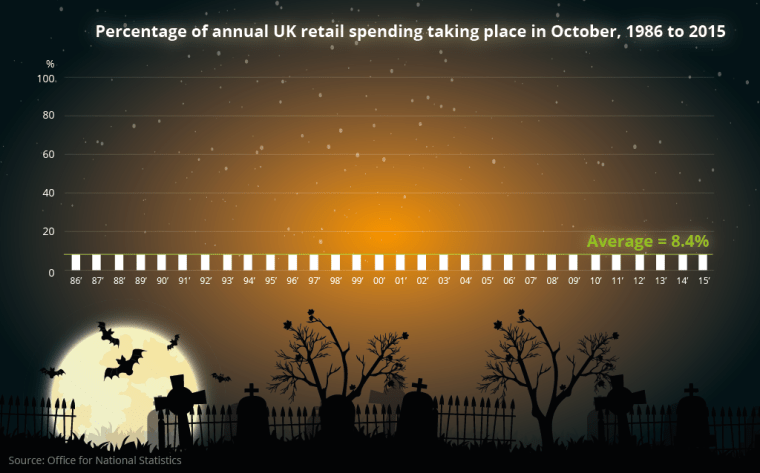
Mintel predicts that spend in the ‘UK is set to reach £320million with a forecast that sales for such products will rise a further 3.2% year-on-year”. Apparently too, there has been a steady increase in celebrations since 1986 as reported by ONS in ‘Five facts about…Halloween – a monster mash of data’. Global Data Online have also carried our some research in 2016 with 72% of consumers thinking that “Halloween is a much larger celebration than it used to be”.

ONSHalloween

There is a lot of detailed Halloween spending analysis in market research held in our library at work. It is generally a great time for all round family fun – “53% of all adults agreeing that Halloween is a really fun event for all the kids” according to You Gov. Our Halloween dressing up is a £78million habit and it is the one time of the year that the whole of the UK are simultaneously in fancy dress and costumes. Driving these sales are low price, wider choices and convenience of supermarkets – which is a big win for the retail sector! Party food, decorations, entertainment and stationery are also consumer goods that have high sales volumes. Fun size bags of confectionery are definitely a main commodity as people get into the trick or treating Halloween spirit.

In a nutshell, these are the things we are spending our money on for Halloween:

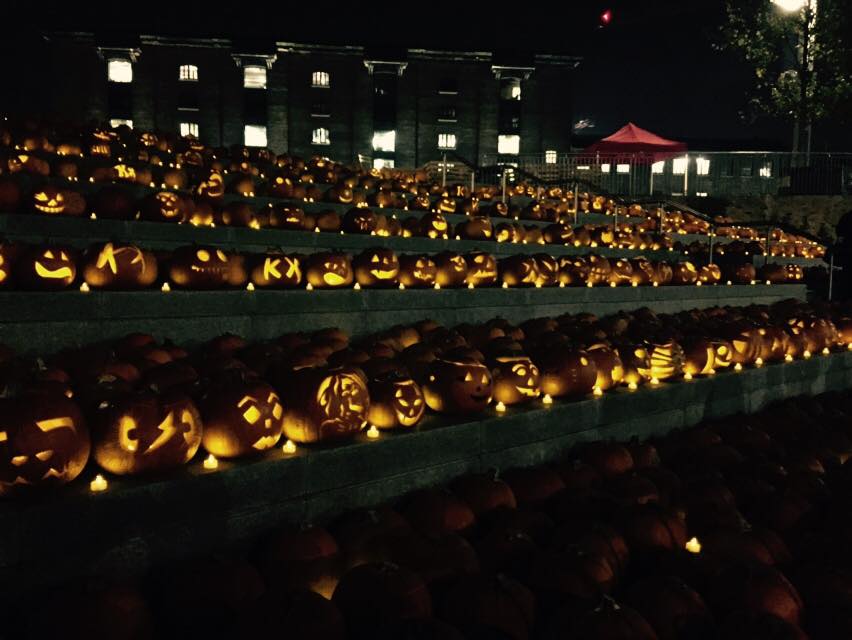
  • Decorations – pumpkins for Jack-o-Lanterns
  • Make-up – to look the part
  • Costumes and Clothing – ideal for fancy dress
  • Halloween Food – food and drink
  • Entertainment – music and events

This slideshow requires JavaScript.

As you may know, I live in Walthamstow and there has been phenomenal regeneration in the high street over the years to bring back our local nightlife with hipsters en tote. There are a few local parties being advertised this week in the run up to the Halloween weekend already. Global Data Online also states that retailers are “posting Halloween-themed social media content through Facebook and Twitter accounts to promote interest among shoppers”. Social Media improves significant retailing opportunities, such as Fanta beverages, who are using Snapchat campaigns on their drink cans and on adverts on digital boards.

This slideshow requires JavaScript.

When I was in the Fundraising and Events committee at a local charity, The Lloyd Park Children Charity – one of our most popular events was our annual Halloween Party and Disco. It was a great fundraiser and our family tickets always sold out well in advance! There were always interesting costumes, decorations, food (some of which I prepared), dancing and music. Our DJ would play classics like Thriller, Monster Mash, Ghostbusters, as well as some contemporary tracks where we can all have a boogie. It was definitely a worthwhile fundraiser, and heart-warming to see families dressed up in a friendly and safe environment.

This slideshow requires JavaScript.

A few years ago, our neighbourly residents group also tried hosting a street party on Halloween Night. It was really busy as this was held on a street with lots of footfall. It was cold, dark and with general naughtiness that we found challenging to manage. We have decided since that it was best when children went about with ad-hoc trick or treating in the neighbourhood.

This slideshow requires JavaScript.

I didn’t play Halloween as a child but my sister played with other children in the Expat community for the school we attended. She told me the tricks they did, and that they chanted the slogan “Trick or Treats. Money or Eats!”

This slideshow requires JavaScript.

A few years ago where I worked, there was an advert for a group flashdance to Michael Jackson’s Thriller. ‘Thrill the World’ as it is known, was organised by an American who also worked for PricewaterhouseCoopers. We all met in a room at the Trocadero, where attendees where able to dress up and practice their dance routine. There were participants who came from outside of London, and they really impressed me as they knew all the moves to Thriller! This worldwide dance initiative is still planned every year and is performed in an open venue.

This slideshow requires JavaScript.

Halloween is also a great time to get creative whether making cakes, costumes, decorations and great art. The Gothic imagery of skulls, spiders, vampires, and dark characters have been a fascination throughout the ages. It is a time of year, apart from Jab Jab Carnival perhaps, where you can let your darker creative juices and talent flow. There are copyright free photos from the 19th century on this British Library link if you are looking for free inspiration.

Last weekend, I also saw the current exhibition ‘Boom for Real’ by the late artist Jean Michel Basquait, and although not all gory – he had a healthy obsession with the ubiquitous skull. His art of the human body was kindled when his mother had presented him with a copy of the book Gray’s Anatomy whilst recovering from an injury from an accident as a child. Like in Basquiat’s artwork, the image of the skull is still seen everywhere at this time of year!

This slideshow requires JavaScript.

Most likely this Halloween, I will see fancy-dressed commuters on their merry way to parties on my way home on the 31st October. I will be hoping to attend some local parties, may be tempted to create my first Jack-o-Lantern, and possibly make a pumpkin inspired pie. Halloween is an old tradition for us to remember the darker and…vulnerable side to the human condition, and quite simply, a time of fun for all the family! We may be at a big party event, a local venue, home or out walking in our neighbourhoods ringing doorbells for some cheerful ‘Trick or Treating’. The least we can do is offer a friendly seasonal hello and welcome.

This slideshow requires JavaScript.

The Brown Atlantic – Indians crossing the seas to the West Indies

Black History Month has been celebrated every October in the United Kingdom for the last 30 years when there are many events showcasing the story and contribution of our diverse history. I wanted to write and reflect a little bit more on my own West Indian heritage. It is something I have to explain regularly.

Are you Indian? Pakistani? Mauritian? …These are frequent questions I have faced since moving to the UK. Because of my brown appearance, I have also been asked on holiday in Spain, Italy and France. In 1995, one elderly solder in Amiens, France called me over to ask me where I was from as he thought I was Brazilian. I have no problem with people asking me where I am from but it is a long story that I frequently have to repeat. It sort of goes like this “…I am Trinidadian but I am Indian by race as my ancestors were Indians who went to the Caribbean as indentured labourers to work on the sugar plantations after the end of slavery”. That is a mouthful! However, it is certainly a true story about Indian Indentureship as a global movement of people to distant lands in the new world that resulted in a human journey rich in history and later integration in what we now know as the West Indies. Some photos here are kindly linked from the UK National Archives image library.

National Archives - 7643279364_eba109e1f6_o
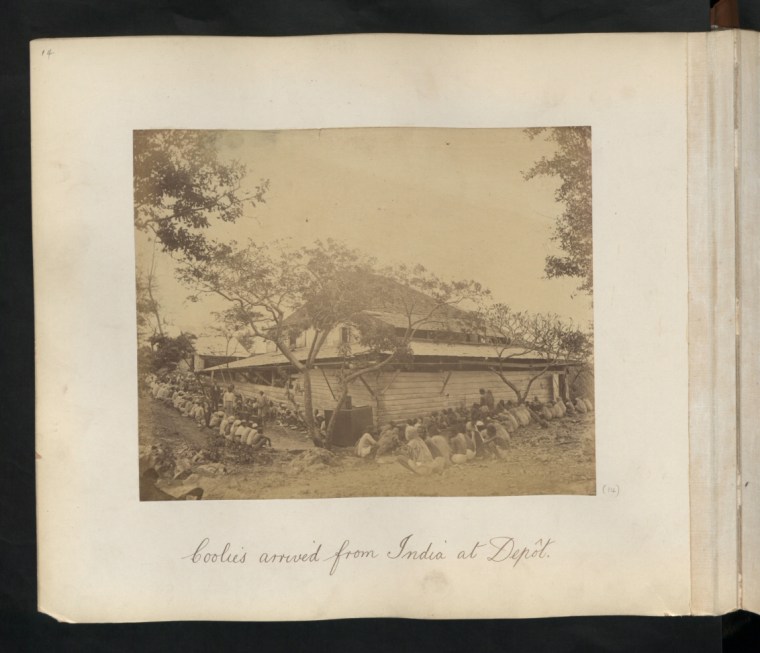
Description: Coolies arrived from India at Depôt. Location: Trinidad and Tobago Date: 1870-1939 Our Catalogue Reference: Part of CO 1069/392 This image is part of the Colonial Office photographic collection held at The National Archives, uploaded as part of the Caribbean Through a Lens project. We have attempted to provide place information for the images automatically but our software may not have found the correct location. We need your help to fill in the gaps, to unearth the missing stories, the social and cultural memories from this selection of colonial recordings. Do you recognise anything or anyone in the photographs? Do they provoke any personal or historical memories? If so, please leave your comments, tags and stories to enrich our records. If you would like to get involved in our community project Caribbean through a lens, we would love to hear from you. For high quality reproductions of any item from our collection please contact our image library

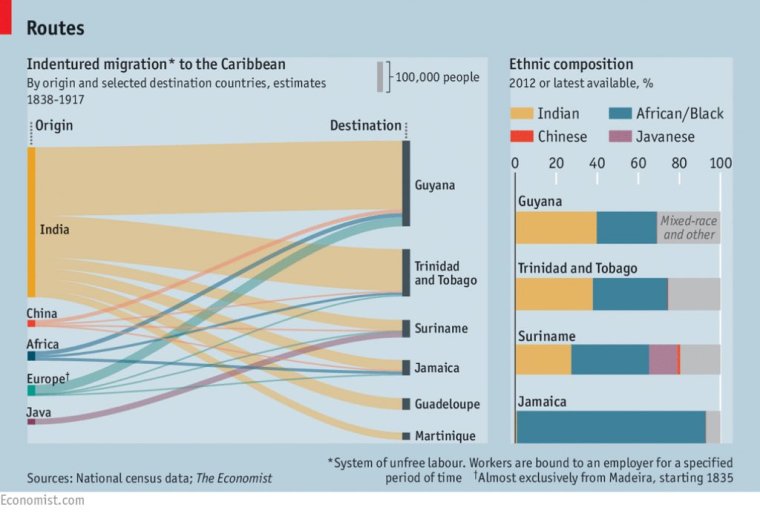
That is the short version. Here I am going to elaborate as it will also serve as a refresher in a voyage of self-discovery. There were a large number of East Indians who moved to the Caribbean as indentured labourers to provide a workforce that would replace the now freed African Slaves. Indentureship was used to entice Chinese, Europeans, Portuguese, Syrians, Lebanese and East Indians in chronological order to the Caribbean. The Fatal Razack was the first ship to bring indentured labourers from India to Trinidad in 1845 with 227 immigrants. This migration continued until 1917 and is referred to as ‘The Brown Atlantic’. There are both positive and negative outcomes of the resulting mass migration as written and discussed by academics, taught at school and oral stories told from my own circles and elders in Trinidad. I have always wondered to myself why my ancestors left India? I am still not sure what were their motives to leave India.

This slideshow requires JavaScript.

Indians were brought to the Caribbean “under dubious circumstances” and lived in the same conditions as some of the former African slaves. Lomash Roopnarine writes in ‘A critique of East Indian Indentured historiography in the Caribbean’ that “Indians were treated more or less like black slaves during indenture with little or no opportunity to challenge the institutionalization of their indenture contract”. It certainly may have had its challenges after leaving Asia in what was considered a highly advanced society, had ancient religions and an already rich culture. Regardless, even though some may argue the ‘wool were pulled over their eyes’, large numbers set bound to new lands across seas and the Atlantic Ocean. Professor Clem Seecharan, at a recent event at the British Library, believes with our collective hindsight, it was also an opportunity to escape from whatever battles or personal baggage our ancestors wanted to leave behind in India. This is the similar story for all immigrants to North and South American in the last four centuries.

This slideshow requires JavaScript.

Growing up in Trinidad, my elder relatives would tell stories of ancestors who came before us to the Caribbean. Unfortunately we have not traced our ancestors back to India, but these anecdotes and stories have been passed on over the 170 plus years. Ideally, it should be documented whilst we can remember the details such as in this archive by the National Council for Indian Culture. Social media has helped recently as older relatives would verify and add what they know to photos of persons and events that occurred. I recently found out that my maternal relations were most likely not indentured labourers but business migrants who came via French Martinique. They were also not based in the plantations, but in the city of Port-of-Spain. One thing that was certain – they were adamant on hanging on to their rich Indian culture, religion and heritage. Who can blame them after seeing for themselves how the colonial imprint had erased other indigenous and migrant cultures in the West Indies.

This slideshow requires JavaScript.

At the time, my ancestors would have found it difficult, if not impossible, to keep in touch with their relations in India – they would eventually lose the connection with these Indian relations, their immediate roots and the location routes that they took before their arrival in the Caribbean. My mother told me a while ago that when they were growing up in the 1950’s, that they had no idea that they would go to India one day. It probably still is a dream for most Trinidadian Indians (Indo-Caribbeans or East Indians as we now called ourselves) to travel back to India one day. In the academic world in the 19th century, “few studies have concentrated on the re-integration of ex-indentured Indians to their former communities and even the second time…the reason for this discontinuity and disconnection in the study of indenture from India and the Caribbean has to do with the great distance and poor communication networks between the two locations. Discontinuity might have to do with language and cultural barriers. The culture of Indians in the Caribbean changed immensely from the original homeland. To some extent, new communities were created overseas”.

Cane field 8023250953_4b60496b7d_o
Description: Trinidad and Tobago. ‘Sugar loading in the south of the island’. Photograph No.: ZZZ 73308 H. Official Trinidad and Tobago photograph compiled by Central Office of Information. Copyright hand stamp of Anne Bolt, Paddington, London, on reverse. Location: Trinidad and Tobago Date: [1948] Our Catalogue Reference: INF 10/359/9 This image is part of the Central Office of Information’s photographic collection held at The National Archives, uploaded as part of the Caribbean Through a Lens project. We need your help to fill in the gaps, to unearth the missing stories, the social and cultural memories from this selection of colonial recordings. Do you recognise anything or anyone in the photographs? Do they provoke any personal or historical memories? If so, please leave your comments, tags and stories to enrich our records. If you would like to get involved in our community project Caribbean through a lens, we would love to hear from you. For high quality reproductions of any item from our collection please contact our image library
This is some of the challenges faced by academics, but the same applies to all descendants. It is a sad result of indentureship but also a warning that immigrants lose links with their ‘Motherland’. My Italian migrant relatives who live in the United Kingdom are considerably more fortunate in that they have only been here over 50 years – they can still speak the language, communicate by modern technology, and travel to the continent is only a few hours away to see relatives. This was not the case and still is not the case with Indian heritage – the family connection has long gone over a hundred years ago! It has only been in the last 25 years or so that affluent Trinidadians are able to travel to their ancestral India in group-organised tours. I haven’t been to India as yet, but still hope to travel there one day.

This slideshow requires JavaScript.

Over time, Indians were able to assimilate and integrate with other migrants in the West Indies. When Indians arrived in Trinidad, “on estates, residents workers of both races shared similar experiences and conditions, although tendency developed for creoles and Indians to do different, specialised tasks”. There was some recording of tensions, such as “Trinidadians of other races were not sympathetic to the new arrivals and they freely expressed their contempt for the Indian religions, culture, method of dress and family life”. In Jamaica, some Indians were “cordially welcomed by their Black brethren, generously offered them oranges, sugarcane, and various descriptions of fruit, as well as bread, cakes, and trifling articles of clothing for their children”. Yet actual conflict between the races was rare. I am sure there would have been tensions at times too, but generally many races and cultures tolerated and got along despite the circumstances. It seems Indians were also in a position to resist and organised discontent against colonial government as the years progressive.

This slideshow requires JavaScript.

I still have a book we used in secondary school called ‘Social Life in the Caribbean 1838-1938’ by Briget Brereton. Reading it again does reinforce some of my own oral stories heard from ancestors such as Indians hanging on to their own traditions, culture and religion. My mother’s family told stories of having only Christian schools in Port-of-Spain, and that they were encouraged to convert but this was vehemently resisted by my Hindu grandparents. Children were also encouraged to work at an early age on the plantations to help in households such as the case with my father. Canadian Presbyterians missionaries were also instrumental in educating young Indian children but also in the hope of converting them to Christianity. Further education schooling for all children were only made compulsory later on. Despite this, it is amazing that so much of their original Indian culture has survived! Indians eventually adopted and integrated Creole Caribbean cultures too, such as Creole fashion, language, names, food, etc. Brereton states, “the educated middle class made up largely of Christian Indians grew up in both territories (Guyana and Trinidad), and was an important group from about 1900”.

This slideshow requires JavaScript.

One point highlighted in my research is that there was few women heroines pointed out, but Roopnarine writes “Are we to believe that the movement of 500000 Indians from their homeland to the Caribbean and years of indentured experience did not produce one single outstanding female indentured servant? From a colonial perspective, this memory never existed.” I also read that Shaleela Hosein interviewed Indian women in rural Trinidad to determine their historical experience through their eyes – “the result is a remarkable oral narrative that exemplifies strength, stability and strong leadership among Indian women in latter stages of indentureship. It seems a contradiction to Indian migrants being subservient and submissive”. From my own family history and neighbourhood – we were told and saw women who worked extremely hard in rural agricultural jobs in the plantations to support their families. Eventually there was, and still is a push and emphasis on education for all. These migrants must have been tough to decide to leave India for the unknown Caribbean, and to make the journey across the Atlantic. This toughness must still be in our DNA. Remember that there was none of today’s modern technology.

This slideshow requires JavaScript.

Coincidently at the British Library, recently I attended a talk based on the book ‘Sugar Sugar –bitter sweet tales of Indian Migrant Worker‘s’ with the author Lainy Malkani and the same Professor Clem Seecharan mentioned above. There was great discussion on this topic, and Professor Seecharan mentioned various thoughts, such as we should see indentureship as an opportunity for our ancestors from what would have been a hierarchical (caste) system in India. It gave people opportunities too to move away and get upwardly mobility. It may have also been a myth that they were not aware of what they were signing up too – some wanted to come to the Caribbean. Apparently some Indians also returned to India, but most indentured migrants stayed.

Recent article. Source: Economist.

It is also very hard to trace migrants as they came from various Indian villages and changed names etc. Professor Seecharan also shared some insight that the French governed Tamils, and they would have settled in Martinique. This also seems to make sense with my maternal ancestors. He was not that enthusiastic about tracing his own family tree to Guyana. It was also the first time I heard about indentured labourers going to work in Fuji – but I was aware of Mauritius, South Africa etc. There were lots of other questions from attendees at the Knowledge Centre event, especially for Indian descendants like myself who now live in the UK. Tracing families in India may be a tough task due to poor and inaccurate record keeping, and would require a lot of time researching through archives and records. It is great if you can trace your background as recently shown for celebrities Liz Bonin and Noel Clarke on the TV Series ‘Who do you think you are’.

This slideshow requires JavaScript.

Indians weren’t always bound or stayed in plantations. Brereton continues that as time passed, Indians adopted “most aspects of western culture and their lifestyle become more and more distant from that of their parents and grandparents. They were businessmen and professionals, civil servants, teachers and clerks, based in towns, especially San Fernando in Trinidad, New Amsterdam and Georgetown in Guyana. They began to form organisations to protect their interest and first entered political life in the early 1900’s”.

It is with pride and admiration that we can now look back at our ancestors who came to the Caribbean and contributed to its’ economic, social, political and cultural development – and made it their home like everybody else. Some notable Indo-Trinidadians are listed here on Wikipedia. There is still a strong link with India for some of the population with simple things such as Bollywood movies, songs and fashion still very popular. Television helped to connect some of the disconnected just as the Internet does today. I recently saw young Trinidadian Indians singing Hindi songs at a wedding and they knew all the lyrics despite not knowing the language. Cricket is also another uniting force with India, Britain and with our African brothers in the Caribbean. Professor Seecharan said that C.L.R. James’s book ‘Beyond the Boundary’ is one of the best books ever written in English, and he obviously had admiration for C.L.R. James.

This slideshow requires JavaScript.

There is much to celebrate personally. My own grandfather was a well-respected businessman by the 1950’s, and my father a dedicated worker with 50 years in the sugar industry. There are many ways that Indo-Caribbeans have contributed to the region and even to the wider world with later migration to Canada, America and the UK. Nobel Prize Winner for Literature, V.S. Naipaul, was a family friend and he has written books that make us look at ourselves such as ‘A House for Mr Biswas’. In the arts and culture, we are tenacious with our own Indian culture, but have also created our own fusions, and some spicy flavours – such as with the Chutney Music genre. Yet too, we are still proactive and keep intact our ancient religions, traditions, language to some extent, fashion, dance, food…and our homes reflect that. Indian Arrival Day is now celebrated annually with a public holiday on 30th May in Trinidad.

7643565602_211f236921_o
Description: 23. Walker Street – the owner is not a barrack dweller. Location: Frederick Village, Trinidad and Tobago Date: 1949 Our Catalogue Reference: Part of CO 1069/401 This image is part of the Colonial Office photographic collection held at The National Archives, uploaded as part of the Caribbean Through a Lens project. We have attempted to provide place information for the images automatically but our software may not have found the correct location. We need your help to fill in the gaps, to unearth the missing stories, the social and cultural memories from this selection of colonial recordings. Do you recognise anything or anyone in the photographs? Do they provoke any personal or historical memories? If so, please leave your comments, tags and stories to enrich our records. If you would like to get involved in our community project Caribbean through a lens, we would love to hear from you. For high quality reproductions of any item from our collection please contact our image library

This post is just scratching the surface of years of history – colonialism, end of slavery and global migration at that! I am a product of that triangular Brown Atlantic passage, and from my perspective – it as a great way to view the world. I also wanted to highlight this rich, sometimes forgotten heritage for Black History Month in October. We know the story of Columbus heading west in his search for East Indian Spices, but his voyage ending up in what is now known as the Americas and Caribbean. Funny and ironic, that my East Indians ancestors eventually also sailed west to settle in the melting pot of the West Indies. It is also great that some of us kept our Indian names in defiance, that our culture has survived but also that there has been integration, inter-racial marriages, social cohesion, fusion, adoption and adaptability with other communities and cultures. Generally it is a great example of the positive influence for multiculturalism and mass immigration that our Indian ancestors have played in the hemisphere. They should be appreciated and celebrated for their innovations, continued development and colourful contribution they make to the region. The journey surely has not ended yet.

This slideshow requires JavaScript.


Notting Hill Carnival – free to dance on the streets

Notting Hill Carnival is the largest street theatre of its kind in Europe having been developed since the late 1950s in London. It is a great participation celebration for Caribbean heritage, culture and identity that has gradually been adopted and inclusive of other similar cultures in the city. I have blogged about Trinidad Carnival here, and the two carnivals are similar but have their own idiosyncrasies and dynamics. The background and roots of this Carnival is European. Europeans celebrated Carnival before lent for Mardi Gras in the Caribbean colonies, this was eventually practised by the African slaves who brought their own rich African traditions, dance, music and song to the party.  Trinidad carnival is the inspiration for the Notting Hill Carnival but it certainly is a different story.

This slideshow requires JavaScript.

Calypso and Caribbean culture came with immigrants in the Windrush years from the Caribbean, and it is even noted that Lord Kitchener wrote the words to ‘London is the place for me whilst on his journey on a ship across the Atlantic Ocean. There was a high number of Trinidadian immigrants who settled in Notting Hill in the 1950s, which was a relatively run down and cheap area to live at the time. These black communities were intimidated by white youths from ‘Teddy Boy’ gangs in 1958, which caused the Race Riots of 1958. The first ‘Caribbean Carnival’ was organised in 1959 for the black community to help with the legal costs of the arrests made that year. The ‘Caribbean Carnival’ was the brainchild of Claudia Jones, a social activist and writer, who arranged the first carnival indoors in cold January 1959 at the St Pancras Hall in King’s Cross, London. I saw notes that it was in a cabaret style, with a Carnival beauty queen competition, steel pans and a dance hall as the grand finale. This carried on for a few years but did not last as Claudia Jones passed away suddenly and unexpectedly in 1964. Eventually the Carnival moved to Notting Hill where most of the Trinidadians immigrants lived, and then was held in the summer. Fifty years on – it has become a part of the social and cultural calendar for Caribbean, Latin American and African descendants and communities. It has also been laced with race and police tensions throughout this time, which I will mention later.

This year is the 51st year of the carnival, and I will be celebrating it in Notting Hill with family and friends. It is a time of year when you will get messages asking if you are taking part in ‘Mas’ as we fondly call it. Our key community leaders chose a band theme when costumes are prepared, materials sourced, created, and then put it all together in the three months leading up to the bank holiday weekend for Notting Hill carnival. There is a lot more that goes on behind the scene, such as the registering of the band with the London Notting Hill Carnival Enterprises, security passes, vehicle hire, food, drinks, DJs, sound systems, etc. We have intentionally kept our band low-key, affordable and non-commercial with a more close-knit group of volunteers and Mas players. This year we are calling our band theme ‘Mas liberation’, with our costumes designs based on Native American Indians attire. I love digging deeper – I will therefore be channelling my inner Pocahontas as we celebrate the 400th death anniversary in the United Kingdom. We have been dressed as  Cleopatras, Sun Goddesses, Sailors, Queen of Hearts, Aliens, for example in past Carnivals. There certainly is community spirit as you volunteer to help in the creation of the costumes in a team effort, and we tend to meet regularly before and during Carnival.   Generally it is good, happy fun in surprisingly…a Carnival atmosphere.

This slideshow requires JavaScript.

I have honestly witnessed both the good and bad side of Carnival. It has always been a ‘resistance festival and art form’. There are times when you see scenes, and can be in a scary situation, usually later in the evening when the tension and pressure builds with youths and the police. There are some carnivals when the tension is more apparent than others – I distinctly remember the 2011 Carnival being a bit tenser as it was just after the London Riots. Our sound system truck was directed to an alternative route and it took a long time getting home with several helicopters circulating overhead – it felt like a war zone, but I was there with people who were close to me so I kept safe. With a large crowd of one million plus people, there are sometimes scuffles by youths, firm control by the police, body searches, and therefore you really should go with friends to enjoy it and to be safe. It is not all cautionary, we do dance and be merry with spectators…and the police too.

21121836_10213697940792979_1507516625_n
Our Carnival Band photo used in British Transport Police Poster for 2017.

Notting Hill is great for signifying creativity, social cohesion, cultural identity and race relations in the capital. It was reported by the LDA that it brings in approximately £93Million to the UK economy. In ‘The Midnight Robber – the artist of Notting Hill’ published in 2007 for City Hall by Lesley Ferris and Adela Ruth Tompsett, the ex-mayor of London Ken Livingstone states that “London is the home to some of the world’s finest Carnival artists who are now in demand across the world serving as cultural ambassadors for London, the UK and the African diaspora”.

This Carnival has grown organically into a successful and important celebration of the UK’s history with its former colonies, and these new London communities. It should be supported, celebrated and evolve into something that has a lasting legacy rather than just the negative rhetoric that is perpetuated by an ignorant media and some politicians. The Carnival doesn’t look like it will stop in the near future, and frankly…it shouldn’t for the thousands of people who go to this part of London to enjoy it. As quoted on the Black Cultural Archives“Carnival is now part of our English heritage, it is about freedom of expression on the streets. Britain would be a very gloomy place without it.” Winston Findlay, Source: Carnival: a photographic and testimonial history of the Notting Hill Carnival by Ismail Blagrove Jr.

This slideshow requires JavaScript.

Calypso, soca, reggae, steel pan, dance and now samba too are some of the other art forms that I look forward to at Notting Hill Carnival, and you get to see and be part of the crowd engagement on this grand scale. As my research reveals, Trinidadians started the Notting Hill Carnival but other West Indian countries joined in the celebrations, such as the Jamaicans with their sound systems in 1975. The Brazilians, Africans and other communities also add some spices over the years. I remember observing this difference in my first carnival here in 1990. As we know now, Carnival is celebrated all across the world such as in Canada for Caribana, Labor Day in New York, Miami, Japan and my British-Trinidadian friends have been on cultural exchange trips to China too. Rihanna has in recent years been ‘breaking the internet’ (like Kim Kardashian) with her Carnival costumes at Barbados’s Crop Over festival. Have a look at the Carnevale Network social media site too, as they are great for sharing news and longer pieces on the global Carnival scene.

This slideshow requires JavaScript.

It is also a time for Caribbean artists to collaborate with their UK counterparts. I just came back from a soca music gig in London and it certainly put us in the mood for Carnival. It is amazing to see so many people dancing to soca and some dancehall, the crowd may be young British…but they knew all the words and moves to the dance tunes. This is scaled up a thousand times for the masqueraders on the road in Notting Hill.

This slideshow requires JavaScript.

“Carnival is always telling you something. It is a language, if you can understand the language then you can read Carnival” – Clary Salandy, Artist and Theatre Designer.

Carnival also means art, creativity and business. Trinidadian-born Clary Salandy is one of many artists and theatre designers who has worked and showcased her costumes in the UK and internationally for various Carnivals, parades, festivals and community art projects. She engages with the local community to pass on her craft but also believes in this as an art form that includes the community as mention in ‘Incremental Art: Negotiating the route to London’s Notting Hill Carnival’ by Lesley Ferris. I only just discovered her too when I saw her featured in the British Airways in-flight magazine this summer. Clary Salandy has a great way to describe her costumes – “A costume is like a visual poem, whether you are 2 or 88”.

The current political mood and devastating situation with the fire at Grenfell in close proximity has highlighted the Notting Hill Carnival this year, and some parts of the population want the carnival to fail. However, Carnival is a symbol and beacon of hope, unity, brotherhood and Britain at its’ multicultural best. All the critics should remember that, and hope it heals rather than it hurts.

This slideshow requires JavaScript.

“Notting Hill as a Place held a special symbolic significance for the West Indians who regarded it as, in the words of one leader, the nearest thing they had to a liberated territory – implicit references to battles they had fought there against white racists in 1958, and against the police in 1970 and 1976. The carnival continued to exist, its greatest political achievement being that it survived at all, in the face of formidable opposition and pressures operating to subvert it all the time.” Abner Cohen

Regardless of the negative media coverage – Carnival is in healthy hands with young designers and masquerade bands. The Internet and social media have also given traction to the positive benefits for Carnival as an art form, empowerment, freedom and cultural identity. The most difficult part is the obvious media bias, misinformation and tension created by the police and delinquents. Sadly, we know that there is some crime and anti-social behaviour – it has always been a tradition of resistance. However, I have been going to the Notting Hill Carnival and would like to advocate that it is mainly a great, peaceful and happy experience where you can feel connected to that rich heritage, and forget the past troubles. There is no better way to share the Carnival’s brilliance but in a cosmopolitan and tolerant city.

This slideshow requires JavaScript.

I clearly recall that Carnival was used as a positive showcase of multicultural and tolerant Britain in the run up to London 2012. It seems to have changed since then. Ferris states, “Many felt that London’s successful bid for the London 2012 Olympics was enhanced by the Carnival art, which demonstrated a vibrant artistic diversity in the nation’s capital. But there is still a long way to go.”

Understanding, acceptance versus bias and other cultural differences means that it will continue to be controversial in this country (have a look at the news and hashtag #NottingHill on Twitter!). Carnival is not mainstream in this country (as it comes out of European Roman Catholic traditions), but Carnival is still celebrated by various communities across the UK, such as in Leeds, Birmingham and other cities holding annual Caribbean Carnivals. We know that we lack funding and support, but for those who understand and want to be part of this special festival and celebration – we ask that you join us in making a new happier and diverse history for generations to come. It is our time to be free and identify with what is ours too. What better way than with everybody dancing on the street!

This slideshow requires JavaScript.

Steady Progress – a lifetime of learning

This month I am coming to you LIVE from my homeland of Trinidad and Tobago, the twin islands in the Caribbean.  I don’t visit home very often so I will definitely indulge myself here and share some photos of the country with you.


This slideshow requires JavaScript.

I am here for my 30th School Anniversary Reunion and a holiday.  Therefore, I have been thinking of my schooling and education in general.  I was fortunate to have my nursery school closeby and my first primary school, Esperanza Presbyterian School, only two houses away from my home.  The motto of this primary school is ‘Knowledge is Power’, and still is today. I was an average achieving child and the teaching focus was on Mathematics. It was fun to go home during breaks, lunchtime and even to use our own toilet.  I remember putting on my mother’s lipstick sometimes in breaks, and doing the privileged things you would do if you live two houses away from your primary school.  I quite liked the school and have fab memories of playing in the school yard at weekends and during the holidays with other children in my neighbourhood.


At the age of seven, I changed schools to attend a private school called Sevilla School for the employees of the now defunct sugar producing company Caroni (1975) Limited. I initially had some difficulty adjusting to the new teaching styles, and a curriculum that was focussed on literacy more so than mathematics. Reading out loud in front of classmates was a dread for me, but my Grade Three teacher, Mrs Lalla, recognized that I needed some extra help.  To assist me with my literacy, she allowed me to take home a book from the school library in the head teacher’s office (Mrs L. L. Mike) to read at home with my mother.  It was not all scary as my forte at that time was in mathematics, learnt at my previous school, and I distinctly remembered getting the equations finished and correct before all my classmates in that grade.  I even received an award, which was the book of the story of Heidi, in my first year in this new school for mathematics at the end of year prize giving ceremony.

The next three years at primary school I eventually caught up in my literacy levels. So much so that I received a prize for ‘Steady Progress’ in my last year, which was a book of Girl Stories which I still have.  My sister on the other hand, had adjusted very quickly to her new school and was very academically inclined.  She won prizes every year in our new school including three prizes one year for Mathematics, Good Citizenship and Perfect Attendance.  There is a Caroni (1975) Limited corporate news article on her in a family album, and I am very proud of her even today.


My next school was Holy Faith Convent, Couva – a secondary school for girls that has been one of the top performing schools in Trinidad.  I had seven happy and memorable years growing up and learning at this school.  Recently, our 30th anniversary school reunion was suggested and organized after most of the school mates joined a Facebook Group.  A few hardworking, committed and kind schoolmates volunteered to help plan and organize our reunion with meetings internationally via Skype, What’s App, email etc. I personally want to thank the main organisers for a terrific weekend for re-connecting with our ‘sisters’, as we fondly like to call ourselves.


This slideshow requires JavaScript.

There are so many wonderful, innocent, brilliant and funny memories we shared at school that it was no surprise that when we all met again after 30 years a couple of weeks ago – we chatted non-stop, and carried on like we haven’t been apart for decades. Some of us have kept in touch over the years, others have fallen off the radar, and three schoolmates sadly have died.  Regardless of time, we share memories and an understanding of a special formative time in our development. Our school song was excellent for transporting us back to those days and reinforcing us with the kind ethos of the school.  Attending an event like this gives you a perspective on where you came from, the journey you made and the road ahead. I was proud to see the girls, now women, and hear about our struggles, the challenges and achievements.  It makes you realise the importance of roots, genuine friends and that basic right…a good education. Learning never really stops.

Thirty years ago our Graduation theme was a ‘Time to Remember’ (my chosen suggestion as it was a song title by Billy Joel).  Our valedictorian then and now is the Honourable Judge Marlene Smith.  Marlene reminded us of her speech and linked it back to us 30 years on to the present with her recital and understanding of T. S. Eliot’s ‘The Four Quartets’ – it all seemed to make sense with time. We are very proud of Marlene and she also came from my village in Trinidad.

Time present and time past
Are both perhaps present in time future
And time future contained in time past.
If all time is eternally present
All time is unredeemable.
What might have been is an abstraction
Remaining a perpetual possibility
Only in a world of speculation.
What might have been and what has been
Point to one end, which is always present.
Footfalls echo in the memory
Down the passage which we did not take
Towards the door we never opened
Into the rose-garden. My words echo
Thus, in your mind.

…T.S. Eliot

We also had thoughts on the current way of the world, gratitude for and anecdotes on our teachers, the nuns in the school convent, praise and even some heckling for our fellow schoolmates.  There was excellent food, drinks, steel pan band, DJ, photographer, songs by students and teachers, and dancing until 2am. The venue was on the East coast of Trinidad and was great for relaxing as well as seeing each other over two days. It was utter fun and I am so glad I came to Trinidad for the reunion – do watch out as we are planning a school reunion in London and Paris in 2021.


This slideshow requires JavaScript.

On the Sunday morning after our reunion, one of my schoolmates offered to lead us on a hike in a nearby rain forest near Salybia. It was an offer I could not refuse as I was looking for something exactly like that for my children to experience.  Akeeta Ali, our hike leader, was amazing and clear at giving us instructions from the onset, pointing out risks, tips and the promise of the beautiful Waterfall at the end of the trail. The trail was wild, muddy, wet, humid and you certainly had to watch your step and hold tight at most times – frequently using the roots of ginormous trees to pull you up or their root groves for support.  The sound of the rivers, birds, animals, fishes and the wind were also spectacular.

Like with most things in life – some of the novice hikers went at a slower pace while the more confident and experienced ones went ahead.  Certainly there was teamwork and camaraderie as we formed groups, and it was good to see the novices take the lead at times within the group.  All in all – I loved every moment of it and the experience was worth it for the beautiful waterfall at the end. We then had to make our way back with the whole exercise lasting about three hours. This is a great exercise for team building and I am pleased I had experienced this type of nature exploration as a child growing up in Trinidad.


This slideshow requires JavaScript.

I am still on holiday in Trinidad and Tobago and there is no place like home!  A place where you have nothing to prove to anyone – you can just be yourself.  I love coming home to Trinidad and Tobago for this reason and it is very nice to spend time with family and friends you haven’t seen for a long time.  The country is also in constant development and it is amazing to see new roads, buildings, shopping malls, foods, musical styles, and reacquaint oneself with the familiar.  It isn’t always a perfect paradise here – there are high levels of crimes for a small island and litter annoys me as much as it does in London – but hopefully this can be changed with some extra pride and public awareness campaigns.


This slideshow requires JavaScript.

As I literally switch off here, most of the year we are busy with work and our own busy interests – but being on holiday is a dedicated period when we can enjoy going at a slower pace, take it easy and to simply relax. My holiday in Trinidad & Tobago is certainly a time for me to rest, before I get ready, steady and get going again in this wild world.

Magnificent Summer Art: roots to blossoms

The summer days are here and I have been looking forward to June with much anticipation. The reason for this excitement is the biennial E17 Art Trail 2017, which ran this month with a STEAM (Science, Technology, Engineering, Arts and Maths) theme. In cold January, some of my neighbours and I met in the pub to discuss how were going to participate in the art trail.  After a brainstorming session, we agreed that we would try to begin the process of creating a community garden in a public space that was a little nondescript, and in need of some attention.  Our title art trail submission from this garden was ‘Tree of Life’ which worked with the existing trees already in the green space, and to highlight the environmental benefits of this little oasis on the corner of a residential area and busy high street.

Earth, Wind and Fire

Sun, Rain

Wind, Snow

Hail, Sleet,

Chaos, Calm

Energy, Light

Day, Night

Earth, Sky

Stars, Moon

Out and Open to the Elements

Our Tree of Life.

by Seema.

Fast forward a few months to June and we have now created a community garden with some community funded that was kindly suggested by our local councilor Cllr Saima Mahmoud. We also found out from Cllr Saima that for the long term, we can nominate the space for a council run project call ‘Making Places’. We most certainly will be looking to develop this place further.

This slideshow requires JavaScript.

In the last few months, I have relished the art elements of helping to create the garden and sourcing STEAM items, such as solar lights, wind chimes, bird nests, paints and other items to showcase the trees. We also got dirty in the process of tidying and clearing the area one weekend, and planted the garden borders another weekend.  Without a doubt – I loved coordinating and decorating the terracotta pots that were distributed to 20 residents too decorate, and then plant them with an outdoor plant.  It was even more pleasurable to get them delivered to my home one by one – it was a privilege to hold them if only temporary in my own garden before the official launch of the E17 Art Trail on 3rd June.

Bob, a local resident, also came up with a brilliant idea to create cogs with the help of the local wood turners, Nichols Brothers, to the STEAM theme.  The cogs were a hit with the garden visitors, and I frequently saw children playing with them as I went past.  I also liked that it reflected the cycle of the life of a tree.  Since then I have paid attention to many by-products from trees – paper, furniture, buildings etc.  I was even inspired to buy a wooden bracelet from a shop off Walthamstow Market that only sold wooden products.

This slideshow requires JavaScript.

We placed STEAM themed poems on one of the trees to add interest to the garden especially as we are officially known as Poet’s Corner E17. We have already showcased poems and stories a few years ago, and coincidently when I was researching this idea, I saw the Royal Botanical Garden in Scotland also had poems on their trees.  John Hudson, a poet with local connections, had one of his poems displayed in their tree…and ours of course! I was also motivated to write some brief poems (some on here, be kind to me!) as they were tweeted during the art trail.

Tree of Life

Give me a…

T – Towering

R – Rejuvenating

E – Energising

E – Elasticity

o – Oxygen

f – Fibrous

L – Living

I – Indigenous

F – Fruitful

E – Evergreen (sometimes)

Tree of Life.

by Seema.

We also wanted to encourage wildlife, and so we sourced two bird nests for one of the trees. I had the pleasure of painting them with my son.  I made a point of tagging on to 1000 Swifts project to raise awareness of Walthamstow Wetlands (one of the largest urban wetlands in Europe), and Swifts as part of the E17 Art Trail. There were literally fabulous artistic Swifts all over Walthamstow that were displayed everywhere locally!  The magic and serendipity was also apparent on social media with RSPB sharing facts and figures about the importance and habits of this extraordinary bird.  Swifts migrate all the way from Africa to Europe each year, and can fly without stopping for days and months.  They became a metaphor to me – the Swifts in flight were like music to my ears…floating and gliding on their merry way, and so I was inspired to include them in the garden.

This slideshow requires JavaScript.

We collaborated with another art trail project called the Bird Box Stories (@birdboxstories). There were several artistically decorated Bird Boxes that were distributed around Walthamstow, and in them they contained a notebook and pens for you to continue the collaborative story. You can also draw a little picture if you preferred.  It was a lovely to continue the story written by someone else whilst sitting and taking in the garden view in the sunshine. Some writers used the Bird Box notebook to give us positive feedback on the garden too!

This slideshow requires JavaScript.

The garden will continue hopefully in the long term as we are going to nominate it in the borough’s Making Places project as mentioned above. Hopefully it will develop into a proper place for the local community, residents and passer-bys near a busy main street with phenomenal amount of regeneration in the area. We really could not leave this spot neglected for much longer.  In our ‘Welcome Hour’ for the opening weekend of the garden, and frequently during the art trail – we had positive feedback from local residents, businesses, strangers and passer-bys on how some simple low-budget items, and plants had transformed the public green space and made it into a ‘place’.  I saw people reading, chatting, reading poems, admiring the space and generally appreciative of what we as residents and volunteers have completed.  It feels very worthwhile!

In the performance art side, we also held a puppet show ‘Vikings and Valkyries’ by E17 Puppets on the road at our new street gallery. The performance was brilliant, funny, interactive and very engaging for children and adults.  Our main concern was that it did not rain on the beautifully handcrafted puppets.  This area of our neighbourhood was recently pedestrianized and it a much more pleasant area than the rat-run it used to be.

This slideshow requires JavaScript.

In the neighbourhood, we certainly had some serious fun with our 6th annual street party with the New York Block party inspired theme.  We had a live funk brass band called ‘The Cracked’, salsa instruction and dancing, serious grooves with our resident DJs and fun activities on one of the hottest summer days of the year. See more photos on our blog here.  Hopefully 40 years in the future…the children will remember these fun times as I remember growing up similarly in Trinidad.

This slideshow requires JavaScript.

I also attended a fab concert a St Mary’s Church in the neighbourhood to see Senegalese Kora player, Seckou Keita, who is one of the best Kora players. The instrument is beautiful (partly made out of a Calabash tree fruit) and made mesmerising music. Seckou Keita was great at telling stories whilst playing the Kora and getting us to sing back, such as in a ‘call and respond’ gospel style.

This slideshow requires JavaScript.

I was so pleased that I was able to see this concert as part of a new initiative call the St Mary’s Art Collective.  The same church also had displays for the art trail which included fab women in STEM by the artist Emma Scutt, a Caribbean Windrush installation and other pieces by young artists.

This slideshow requires JavaScript.

It was funny that week as I went to churches three times for art trailing and social reasons! I also went into Westminster Abbey for a work-related Summer Reception and was impressed with the 1200s era mural, Poets Corner, stained glass windows and other interesting features of the abbey.  It was the first time I went inside the abbey after remembering Prince Andrew’s and Sarah Ferguson’s wedding televised live to Trinidad, as well as other televised state occasions since then.  I also visited St Saviour’s Church in Walthamstow to see Veronique’s, my friend, art trail display.  I even bought one of her pieces and she was raising funds for a local charity she supports called Carefree Kids.

This slideshow requires JavaScript.

Special thanks to all the neighbours who helped create the community garden and also for the E17 Art Trail team for giving us the opportunity to create art in a place where we live for the whole community and guests.  There is always something creative going on in my neighbourhood, where I work and sometimes at home. So I may seem relentless on social media, as some of you have mentioned to me.  I can only explain that there is some special energy where I am, or it is just me being me.

If you want to see my neighbourhood’s art heritage, the ‘Be Magnificent’ exhibition on the art school influence of Walthamstow School of Art 1957-1967 is currently on at William Morris Gallery. This really is a motivation place to get your creative sparks, heat and inspiration.  Like our ‘Tree of Life’ small community garden in its’ natural living form, and with future plans for development of the place – the roots are there with hope and aspiration for its’ future, and I have an inkling feeling that out of this small art project, the best is yet to come!

This slideshow requires JavaScript.


Information Superhighway: access all areas

The Information Superhighway was a term used when I started working in the information industry in the early 1990’s. There are also a few books published on the topic at the time and my manager ordered some for our collection in the library where I worked. Recently I was reminiscing with my ex-colleague, Lina Kouzi, about this and we discussed how revolutionary it was at the time. That was about 24 years ago…before “everyone” used the web. I had already attended lectures at university on the “information society” vision that was a precursor to the information superhighway or cyberspace, as we now know it. All of this is history, but there are two aspects of the information and library world that will remain relevant even now: (1) Some people can use web-based sources very easily for their information needs, cruise at their leisure and/or accelerate in the fast lane for such things as the deep web and e-commerce. But (2) there are also parts of society and the developing world that do not have access to this road – much less so to a superhighway. These access barriers get forgotten sometimes.

Librarians and information professionals are always keen to help users to access content regardless of format, and to provide content that is relevant, correct, critically analysed within research frameworks and standards in various fields of interest.

This month, it was such a pleasure to volunteer to represent SLA Europe in Dublin for the inaugural Information Professional Career Expo at the Dublin Business School in Ireland. I was keen to meet professionals and new graduates in the Irish Information Community and to make time to see my ex-colleague and friend Lina at the National Council for the Blind in Ireland (NCBI). I flew into Dublin City Airport early in the morning and Lina took me straight to her office at the NCBI. I have kept track of Lina’s amazing work over the years and I find the library and media services she provides to the blind and partially sighted to users across Ireland awesome and inspiring! There are many features about their services that are unique and tailored for their users, such as a collection of braille resources and various media output in audio recordings of news, magazines (journals), books, etc. Lina showed we around the purpose built office in the Dublin suburbs with traditional library storage, but also with BBC standard built recording studios and booths. It was also very nice to be introduced to her colleagues, and I made sure I told them how amazing their work is to their users.

This slideshow requires JavaScript.

Lina is also working with the local residents in a deprived community on a programme for up-skilling and training with recording items from the collection to be sent to users. I also saw the postal bags for materials that are sent out across Ireland free of postage charges, and with easy postal bags for users who may find it challenging to return items to the library. Some of her users have access to content on memory USB sticks, which are then returned in these postal bags (see photo). Library users have machines and devices for playing the audio materials that they receive from the NCBI. Obviously, there are younger users who may have smarter technology but some of them still use tradition and antiquated machines, as they are familiar with the machines. Lina created an annual report with some amazing facts and figures of their work and the valuable contribution they provide for their users and the positive impact this service has on users’ quality of life.

We both loved catching up and it was non-stop chatting on old and new stories. That is the beauty of being with an old friend – you pick up where you left off! We both quietly recalled and congratulated each other on our careers’ progress and how those early days at Coopers & Lybrand (now PricewaterhouseCoopers) were foundations skills and learning in the ‘Books’ and ‘Journals’ sections even in a corporate library – the experience is still relevant to the services we provide today in our current roles in terms of the ‘content’, transferable and business skills that we possess.

This slideshow requires JavaScript.

After a quick lunch at the Temple Bar district of Dublin, I made a quick dash in the Dublin Taxi to the inaugural Information Professionals Career Expo at the Dublin Business School (DBS). Bursting with energy and excitement after seeing my dear friend, I entered the expo in full swing to a warm welcome to meet Irish SLA Europe members and DBS contacts Siobhan McGuinness, Neasa McHale and Marie O’Neill. I was mainly here to network, exalt the benefits of SLA Europe as a global network of information professionals and to give advice to anyone who wanted to chat at our stall.  I had the pleasure of meeting a few new graduates and gave then a few tips on how they can keep in contact with SLA Europe and what we are up to by our social media channels.  I also spoke on some of the more important CPD and social events we host. I gave tips on job seeking and staying on top of their personal development and seeking emerging new roles as well as traditional ones.

In the general career mentoring area, I also met Florence Curley from PricewaterhouseCoopers (PwC).  Florence and I (like many other geographical territories) used to communicate to exchange information and assist each other in finding information or leads for our library users.  It was nice to meet someone in person you have never met before – even if it was 10 years ago that I left PwC!

It was also a pleasure to give a short talk at the start of the SLA Europe hosted networking and nibbles, where I was introduced by Philip of the Library Association in Ireland.  Philip set the tone with any introduction that called for information professionals to be excited to “put information in the hands of their users”, but also to “fight the good fight” with all the changes in the industry. I had prepared for a light-hearted talk on my career and what SLA Europe has meant for me and my own professional development, but I went on to mention thoughts that was hopefully motivational, encouraging and praiseworthy. I also urged the room to be prepared for the fight that we face as information professionals.  There are various roles, industries, subjects and creative cultural aspects of our valuable contribution – and I made sure that point was not missed.  Siobhan has written a fab Information Professional Expo event review here.

It was really nice to meet many of the group attending the nibbles and networking afterwards for a more personal chat on issues and opportunities that they may face. It was a true pleasure to attend these different venues in Dublin with varied user experiences and professional elements, which personally put the library and information industry into clearer perspective on the roads that lie ahead.

My time in Dublin was not all work and I was able to take a nice walk to my hotel, spend the evening listening to live music in my music-themed hotel and go by train to Galway the next morning.  I have visited Ireland before about 15 years ago for St Patrick’s Day, and definitely, it is a fabulous city that is worth a visit.  The countryside on the way to Galway was beautiful and very cliche green with livestock roaming the fields.  It was such a joy to see the animals resting, playing or grazing in the green grass of Ireland.  Galway was really nice as shown in my photos and I hope to visit Ireland again one day to see more of the countryside.

This slideshow requires JavaScript.

Not only did I spend time speed networking in Dublin, but I also attended the Business Show as part of the Business & IP Centre team at Excel in May.  It is amazing that information is ubiquitious and accessible night and day in the palm of our hands, but people still want face to face information or pointers for those hard-to-find information needs.  Even if it is to reassure them what they already know.  I assisted with about 15 speed mentoring sessions for the London Growth Hub at the Business Show and most speed mentees wanted information that was practical or confirmation of where they can go to find out what they were looking for. The Information Superhighway may be all well and good but there is still a need for information professionals to provide that face-to-face conversation or provide answers that some people still need…and they may prefer to communicate in person. We still do this everyday in the library where I work.

Fake News and digital literacy are other issues that have come to the forefront in the last year.  This had probably been exasperated by social media and mainstream news being manipulated by the powerful.  This is not a new issue and I have been interesting in the topic for a while but not overly passionate about it.  There is a fabulous article in Information Today May 2017 entitled ‘What’s behind fake news and What you can do about it‘ by Kate Dempsey – which gives some fabulous insight into the role of information professionals and librarians in fact-checking and preventing the spread of misinformation. Tracey end by stating “It is vital to prove your continued value, and this is a timely, powerful way to do it. It’s one thing to repeat the old trope ‘People need libraries now more than ever,’ and that is another thing to get out there to prove it”.

It is vital to prove your continued value, and this is a timely, powerful way to do it. It’s one thing to repeat the old trope ‘People need libraries now more than ever,’ and that is another thing to get out there to prove it” – Information Today, May 2017, ‘What’s behind fake news and What you can do about it‘ by Kate Dempsey.

As with all content, we eventually will manage archives for future scrutiny, analysis and fact-checking. We are here to provide accurate, impartial and unbias information for independent research and for the empowerment of our users. This is not always easy, appreciated or even possible, but we professional won’t have it any other way!  It is our standards. So if you get away with half-truths or disinformation – we will eventually catch up with you in time!  I remember telling the attendees at the networking event in Dublin that I would have changed my career by now if I didn’t like being an information professional. I haven’t always had the “luck of the Irish” in my career…but I do feel lucky to do what I do.  Information works for me.

18582419_10212742283542145_7040794935090751454_n
Emerald – Ireland from the airplane.

Fashion Conscious

I am not an expert, queen or slave to fashion but like most people, I have a keen interest in fashion throughout the ages. Growing up with lots of women and female cousins around me meant that we would chat, admire and pass on hand-me-downs items of clothing. I think that was such a lovely and memorable part of growing up. Again, I repeat that I come from a little island in the Caribbean but we were still in step with fashion trends. Matriarchs in my family have some fabulous photos of classic late 1950’s and 1960’s fashion, and some of these would look just as on trend today! There are two points that I like about this – the sustainability of sharing unwanted clothes with close ones, and the important creative inspiration that fashion archives are for new creations and innovations.

This slideshow requires JavaScript.

It is so easy to find historic fashion on the web in various fashion archives. I follow Europeana on Twitter @Eurofashion, and I’m warning you that they frequently share real treasure designs and photos that will give you fashion flashbacks! The special thing about fashion is that it can still seem very fresh in the right context and setting. I am lucky because as I work at the British Library…and we have access to archived fashion books, magazines (Vogue archive) and even dress patterns.

This slideshow requires JavaScript.

I have also met many start-up businesses that are using the current research resources to plan and grow their businesses from designing and selling fashion from childrenswear, women’s plus sizes, womenswear and menswear, lingerie, shoes, handbags etc. The fashion opportunities are endless. I have also blogged about fashion along these same lines here in this link in ‘Fashion has nowhere to go but in Circles’ on the Business & IP Centre’s blog.

This slideshow requires JavaScript.

IMG_1308 (1)
Jumpsuit

Customised and seamstress dressmaking was a great aspect of growing up in 1970’s and 1980’s Trinidad. We had fashion shops, markets and shopping malls but it was still special when we would go with our specific designs to seamstresses for these designs to be made uniquely in the fabric, colour and made-to-measure for ourselves. Before the internet, we would get fashion and design ideas from television, film, music videos and American shopping catalogues too – such as JC Penny. I remember a few seamstresses that used their dressmaking skills as a livelihood and business to support their families. Presently, some of my friends are keen dressmakers at home for their own consumption, and have been creating fashion pieces in their spare time to their preferred tastes, which I think is amazing!

One of my favourite customised outfits I remember, and have a photo of, was my first jumpsuit! I was about 7 years old and my lovely grown up neighbour, Radica, took me with her to San Fernando (a city in Southern Trinidad) to get it made. I remember the cotton denim look and the little red berries pattern on the fabric. I loved it! Jumpsuits were initially a world fashion trend in the 1970s (possibly older). However even then, I remember that it was awkward to go to the lavatory in a jumpsuit. Fast forward to the present – and the jumpsuit is back as seen in these Pinterest curated photos. And I am still trying to perfect the art of using a jumpsuit at parties and festivals.

IMG_1307 (1)
Jumpsuit for a boat party – Summer 2016.

Continue reading “Fashion Conscious”