Make way for more Women


InternationalWomensDay-portrait

As we celebrate International Women’s Day 2016, I am already pleased to see that there has been a lot of media (especially social media) coverage on this special occasion, which also falls in Women’s History Month.  The theme for this year is ‘Pledge for Parity’ which sets the tone for us to call for more equal opportunities for women everywhere.

The library and information playing field is fairly even and predominantly in favour of female professionals, but apparently men still hold senior roles. I have no personal battles with equality in my profession and employment otherwise. However, it may not be so rosy in other lines of work and in life in general. Although we have progressed in many ways over the years, the gender inequality statistics (World Economic Forum) show the facts, barriers, struggles, prejudices, stresses, glass-ceilings and rocky-paths are still here today.

Self-worth and self-belief are integral to understanding my intentions for joining the conversation on here.  This stems from having great female role models that I have been fortunate enough to have in my early life in Trinidad. Some of these women include my mother, who is definitely a role model for her gentle, philosophical and giving nature. In the Caribbean growing up with my late sister, aunties, cousins, neighbours and schoolgirls was very formative and played a big part in the early stages of ‘The Sisterhood’. I also went to an all-girl secondary convent school established by the Holy Faith Sisters for seven years, where we had strong and intelligent teachers and nuns to educate us.  We were encouraged to do well, to achieve and to aim high in our future endeavours, before we developed into young women.  It might all be in hindsight and viewed with maturity, but this willingness for all of us to progress has made me, not just want the best for myself, but also for my friends and family. There was no easy way to get where we are today, and it feels even better when we are all achieving and progressing well. This is my reason for using Madeleine Albright’s quote below – a gentle reminder.

‘There is a special place in hell for women who don’t help other women’.

– Madeleine Albright. American Politician and Diplomat.

At university many moons ago, we were asked to do a social history matrix, and coincidently, I was in the group that focussed on feminism from the 1800s to the early 1990s.  This project made us research feminism from the industrial revolution, through the Women’s Liberation Movement, and right up to the modern late 20th century.  I enjoyed researching British feminism then, and learnt a lot about Emmeline Pankhurst, and her contemporaries in the Suffragette Movement.  These women were some of our feminist pioneers, and they paved the way for huge leaps in women’s equality and opportunities not just in the United Kingdom, but across the globe.

One of the great reasons for working in libraries and information centres is that we help all types of people regardless of gender, age, colour, geography, hierarchy, etc. We must be inclusive as well as diverse in subject and access. We are an open door in a physical and virtual space for interaction, services and knowledge-sharing. I have no ‘hang ups’ with anyone on this basic service level -all that is essential is mutual respect and understanding. These are the core principles and foundation for collaboration, progression and advancement for any business, and also is essential for advanced societies.

In my work at the British Library’s Business & IP Centre, women make up a large amount of our customers. They are mainly using the Centre to research, learn, create, start and grow their own businesses. Women (and their business partners) are literally “doing it for themselves” – finding independence by owning their own businesses. They may be working extra-hard in the day-job initially but more than likely, are having to manage and balance a home-life and any other commitments. The same goes to male entrepreneurs too. All startups require flexibility and an extra dose of harmony, especially if you are in a relationship or have a family. I have heard many real stories by successful entrepreneurs where family plays a big part in supporting or defining a successful business.
ba724cd4a2a27cb3ed92db6ab8a2b1d2

Another British Library rich resource that was launched a few years ago is the feminist Sisterhood and After archive. I have spent a few hours listening to real poignant stories of the Women’s Liberation Movement covering heavy topics such as abortion, working conditions, childbirth, education, equality, rights, sex, love etc. This is a great educational tool, and a fascinating archive for generations to come. In the library’s conference centre, I have also attended some feminist talks which were enlightening, funny and inspiring due to their historic nature and the personal stories told by real women activists.

This week also sees the return of the Women of the World  festival in London’s Southbank Centre. I attended about five years ago to see the great Annie Lennox (what a heroine and champion!), Emile Sande and Katy B in concert.  During the concert, Annie reminded us of some of the scary facts about the work that still needs to be done for women and girls across the globe. She also sweetly coerced us to declare loud and clear that “We are feminists!”. There is no doubt about it. Even if I wasn’t sure then, I said “I am a feminist!”. I saw her point in asking us together to be transparent and advocates on this serious issue.

419312_3369076475899_528674727_n

In our ‘first world’, life may not be so difficult as some of the stories we hear of in the less developed countries of the world, but our struggles are slightly bearable due to the opportunities available to us.

I had the benefit of attending the last Precious Awards founded by the inspirational Foluke Akinlose. It was admirable to see women and men of colour recognised in their various roles in all fields of life. Attending and nominated for their outstanding levels of achievement ranging from law, corporations, entrepreneurs, self-employed, artists, engineers and charities.  The speaker from Barclays Bank gave us some facts on the level of success for women, but also mentioned that it is even harder for women of colour to achieve in the United Kingdom. However, the great benefit of the Precious Awards ceremony was to recognise these women and men who are able to make their own luck, take destiny in their own hands and even better…break down the barriers for a successful pathway. Foluke mentioned that these winners will also be fabulous role models and an inspiration for younger generations to follow.

For International Women’s Day 2016, I haven’t planned or organised an event, as I have had in the past. I will be keeping track of community events in Walthamstow Central Library which I think will be very engaging. I will also be attending a fun talk and comedy night at a local pub Ye Olde Rose and Crown where the funds are going to support the End to FGM.  As usual, I will be secretly happy, pleased and connected online and spiritually to all the celebrations across the world.  I know that women and girls will come together to celebrate, demonstrate, protest, voice concerns, laugh, and most of all – support each other in what at times can be a cruel and unequal world as together we pledge for parity.

Trinidad Carnival is Colour

Well, I have finally done it! I have my very own blog after many years of suggestions from friends and acquaintances that I should have my own online space.  I am a fairly prolific social media user, have blogged for work, guest blogged and used collaborative technologies since the 1990’s as work in libraries and information centres.

In the past I am too busy with other things to have time to blog, but I feel the time has come to merge my stories as they become interwoven into one space.  It may be easier for me to do this here due to the info centric, rich connections and experiences I encounter in my simple life, community, work and profession.  Let’s face it … this online space is for everyone to use for good and I also want to use this as an archive for future reference.

For my first post, I wanted to write briefly about Trinidad Carnival which occurs every year two days before Mardi Gras, directly followed by Ash Wednesday and Lent.  It is a time of year where I instinctively feel excited, and try to tune in from wintery cold England to the heat, energy, bursting creativity and vibrant colours or as wef4ffd61ffe17e19013e28c4547029b39 say… bacchanal (derived from bacchus) that is Trinidad Carnival.

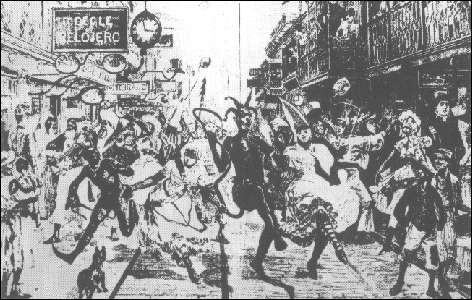
The history of Trinidad Carnival is long and goes back to the 18th Century when the European plantations owners celebrated masquerades before lent.  Their African slaves were not allow to take part but formed their own caboulay celebrations. Here they developed mas’ (abbreviated from masquerade) as we know it now – whereby African musical and dance traditions fused with European masks and costumes into an eclectic and exotic mix.


And so I am writing this in London, but my heart strays away to the land of my birth this time of year. From as early as I can remember, I can remember Carnival! Carnival is part of the Trinidadian (Trini for short) psyche, mindset and makeup (no pun intended). Children would take part in schools by making masks and costumes. Usually schools arrange a bit of a “jump up” dance for the parading of these creations on the Friday before the Carnival weekend. There would be an extra tinge of excitement in the air as it is the start of four days of holidays for the Carnival celebrations. The actual big and commercial celebrations usually start the previous year with the launch of Carnival bands, parties or ‘fete’ as we say, being once a French colony. This is big business now, for when one Carnival finishes, the planning for the next year starts immediately after a short break.

I found some gems of carnival video clips from the 1950s when British Pathe digitised their archive.  The effort that went into the costumes are stunning with wonderful results.  I wondered if they were funded centrally or whether the costumes were made out of their own pockets! Anyway, I love the themes such as American Native Indians, Egyptians and all the other finer details in the mas. In the 1970s and 1980s, I had noticed even then that cameras and broadcasters transmitting the parades to people’s homes and possibly abroad.

As a child, I used to be excited waking up on Carnival weekend as the whole weekend would be a visual and rhythmical treat. Saturdays during the day would be filled watching on television the ‘Kiddies Carnival’ and later that night, some of the steel pan ‘Panorama’ competitions. The show usually finishes late, so I sometimes never saw all of the steel bands. What people don’t realise – the steel bands themselves in Trinidad are massive and consist of scores of musicians and organisers.  The orchestras fill a large part of the epicentre of the competitions at the Queen’s Park Savannah stage. The flag bearers were generally women who danced away to the steel drums on stage and were a treat to watch too – they waved it and shaked it!

On Sunday there would be the Dimanche Gras competition showcasing the large Kings and Queens Carnival costumes and the Calypso competition.  This is no longer the competiton format but it was exciting to see it then over the weekend.  The televised shows always made exciting live viewing and that was very special about Trinidad (this year I listened to live radio via the web in London and have seen live streaming on the web too in the recent years!).   

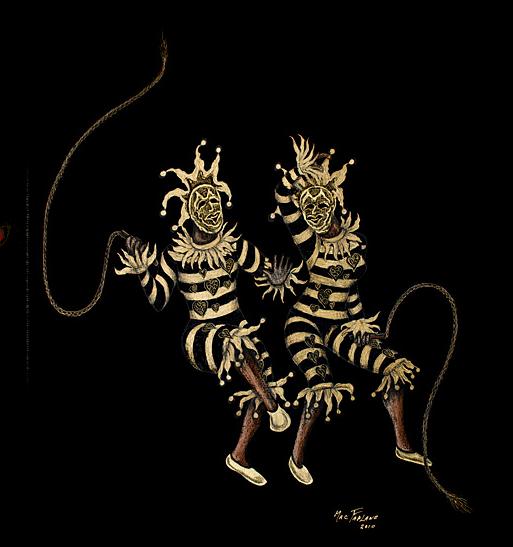
I remember the costumes being very elaborate and colourful in the late 70s and 80s. Now the costumes are still beautiful but a bit monotonous, as they are mainly bejewelled bikinis with feathers.  Don’t get me wrong – I guess this has made mas more accessible and now everyone can afford to participate in a piece of the action in an all-inclusive Carnival band.  A relative told me that most of the big bands mas are currently manufactured in China. However, I saw a few years ago that some top designers such as Brian Macfarlane still make theatrical theme-based mas, and also there are still organically handmade costumes in some communities across Trinidad.

mcfarlane-jab-jab
Jab Jab – Brian MacFarlane.

On Carnival Mondays, we would wake up to young children in my hometown Dow Village wearing their homemade masks.  They will go door to door chanting slogans and making noisy music with a pan and stick expecting small money for their efforts.  Pocket money  was given as an appreciation for their efforts.  Sadly, I understand this tradition doesn’t happen now in my village. From early morning on Carnival Monday when it is still dark, there would be live television broadcasting of J’ouvert – the official start of the adult Carnival on the streets of the cities.  I only attended J’ouvert once in Port-of-Spain circa 1985 with relatives and we got there for about 3am in the dark.  It was amazing to witness and participate in a celebration with people dancing on the streets at that time in the early hours of the morning.  The debauchery, dancing and parading would continue into the daylight of mid-morning. This is broadcasted on live television too, if you can’t go out to the streets. In recent years in London, I love seeing dawn tweets of Trinidad J’ouvert on Twitter.

J’ouvert leads on to the official parades of bands. Historically there is no wasting of time on the start of Carnival and revellers make the most of time before the Ash Wednesdays cool-down.  The rest of the day would be spent watching the Monday parades of bands on the Television.  My village had traditional celebrations such as Jab Jabs (derived from Spanish for diablo) dressed as devils with whips.  Unique to my village, some East Indians in the community would also have a parade to the beat of East Indian tassa drums to the next main town Couva.

On the final day that is Carnival Tuesday, our parents would always take us to Port-of-Spain (my mother’s hometown) to see the mas meeting up with our large family with homemade picnics and snacks for the day including delicacies like our own Trinidadian pilau (mixed rice dish with meat, pigeon peas and vegetables).  There we would be based all day to see the great and traditional masqueraders displayed on the Queen’s Park Savannah stage.  We would see traditional masqueraders such as the Sailor Bands, Midnight Robbers, American Indians, Minstrels, Moko Jumbies on stilts and blue devils covered with blue powder to name a few characters. There too, we saw the great bands of 3000 plus masquerade members by designers such as Raoul Garib, Wayne Berkeley, Stephen Lee Heung and my all time favourite designer – the world renown Peter Minshall.

Peter Minshall not only created beautiful exquisitely designed costumes for Kings, Queens and his band members – he retained the theatrical themes and origins of the mas with performances on the main Queen’s Park Savannah stage. Frequently his costume designs were provocative for social and political commentary with theatre and drama.  For example, I remember vividly on television the King of Carnival performance and showcasing of Mancrab for his band theme ‘The River’ – it was pure drama!  This was aired live on television to the movement and sound of calypso music.  I still think of the year he created the band Rat Race and the vision of hundreds of people dressed as Rats in the ‘savannah’ and on the streets of Port-of-Spain.  It is hard to cover all the beauty, vibrancy and growing up with Trinidad Carnival but they are cherished memories of the creativity and the celebration of our people.

71e9ba6f8dbf6f74f5bf557e14a01e2c
Rat Race by Peter Minshall.

On the business side of Carnival, Minshall is renowned for exporting his talent and creations at major global events such as the Barcelona and Atlanta Georgia Olympic Games Opening ceremonies.  He is also credited for designing the Tall Boy which he patented and invented with Doron Gazit.  It was great to see him also back from a haitus from Carnival in 2016 with his design of ‘The Dying Swan’.

There would be no Carnival without music.  Kaiso and the oral traditions came over with African Slaves and evolved into calypso and eventually to the modern day soca (soul and calypso).  The development of this music genre is innovative and laced with fusion beats and can be social and political commentary but generally is more upbeat, rhythmic with innuendos for having a good time.  Nothing can beat a good calypso to get a fete going or everybody on a dance floor or street. I still actively look forward to the new music releases and social media is a great tool for that hobby.  I remember when I first came to London, I had no clue what the latest releases were as I tend to listen to mainstream British radio and not the UK soca radio stations.  I used to receive cassettes sent over with relatives who went to holiday to Trinidad. Thankfully now I can find music on online radio stations, You Tube and via my own social network.  Forbes recently published a list of Carnival Entrepreneurs with the Trinidad Carnival Powerlist and there is much talk that soca music is finally going mainstream. I hope so, with so many Caribbean Carnivals being celebrated across the globe.

This slideshow requires JavaScript.

At the British Library where I currently work, this is the final week for the dazzling exhibition ‘West Africa: Word, Symbol, Song’. I am extremely grateful to the curators of the exhibition for helping me understand the world and for my own self-discovery as an Indian-Trinidadian. I learnt so much about West African culture and its oral traditions, ancient manuscripts, symbols, fabric, musical instruments, musical history and art forms. It was also an immense pleasure to see the ‘Carnival Queen’ designed by fellow Trinidadian Ray Mahabir on the speaker-box with a nucleus of calypso and soca music curated to visuals of Nottinghill Carnival inside the speaker-box. Being in there, it was one of the moments when you can see all the dots joining up – a world connected. Old with the new.

Being in there, it was one of the moments when you can see all the dots joining up – a world connected. Old with the new.

I feel I can write a book on my experiences on Carnival, which has been dubbed a long time ago as the greatest show on Earth. I borrowed a few books to research from the British Library before my visit last year for Trinidad Carnival, and it has been documented for its social, cultural and delightful impact.

Today in London,  I wanted to remind those who know me that it is Carnival Tuesday and I can’t help my thoughts straying to Trinidad and that infectious energy, freedom, rhythms, empowerment and colour of my country and the people.   Later this year, I look forward to a little bit of that enjoyment at the Notting Hill Carnival in August.

This slideshow requires JavaScript.